Tag Archives: Historical Context

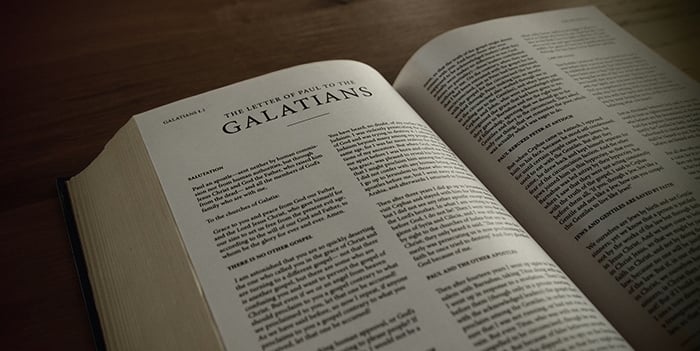
On Historical Context in Galatians

It has been said on more than one occasion that “A text without a context is a pretext for a prooftext.” The point is that faithful bible reading must take the historical and literary context of the text into consideration. God spoke through real people living real lives with real questions, and in order to understand His Word, we must read it on its own terms, that is to say we must seek to understand it as it would have been understood by its intended audience. We must put ourselves into their shoes, so to speak, and look at things through their eyes. Then, and only then, will we be able to draw the parallel applications that transform our own lives. However, in the academic study of the New Testament, historical reconstructions of the life and times of the biblical audience can sometimes feel overly speculative and somewhat disconnected from the actual text. This is why, no matter how sophisticated our historical reconstruction may be, we must ask the question, “How does this help me to understand the text better?,” because at the end of the day, biblical studies is an irreducibly textual endeavor.

I recently had this point reiterated to me by a brother who is preparing to teach Paul’s Letter to the Galatians in our adult Sunday school class. Of course, the basic situation in Galatians is pretty straightforward. The newly converted Gentile Christians in Galatia are facing social and theological pressure from a group of Jewish “Christians” to be circumcised, so that they can truly be part of God’s (Jewish) people. This is a position that the Apostle Paul simply will not countenance under any circumstances; in fact, he condemns it outright in some of the harshest language in all of the New Testament. “As we have said before, I now say again: If anyone is preaching to you a gospel contrary to what you received, a curse be on him!” (1.9) Of course, Paul goes on in the letter to give historical and theological arguments against the position in question in chapters 3-4, and then he uses chapters 5-6 to emphasize those virtues and habits of character that truly distinguish someone as belonging to the people of God. In other words, the message of the letter is pretty clear.

However, we must ask whether or not this is all way can say about the situation in Galatians, particularly as this relates to chapters 1-2 and their relationship with the events in Acts 9-15. In these first two chapters, Paul gives a brief history of his own salvation and his relationship with the Jerusalem church; his point is that his gospel is not based on the traditions of men, but on the supernatural revelation of God himself in the person of Christ on the Damascus road. But the correspondence between Paul’s testimony and the events in Acts is less than clear to say the least. Of course, there are some that would say that the two are inherently incompatible, and to attempt any kind of combined reconstruction is hopeless and probably not even necessary. But for those of us who hold convictions regarding the inerrancy of the Scriptures, this is simply not an option. We must ask questions regarding the text’s larger coherence with the New Testament witness, especially when that text addresses events that are recorded by another author. For example, is the Jerusalem visit that Paul mentions in 2.1-10 to be understood as corresponding his visit at the Jerusalem council as it is recorded in Acts 15, or is it the famine visit that is mentioned in Acts 11? Who are these “men from James” (2.12), and what is the purpose of their visit in Antioch? Are they part of the circumcision party? Why would Peter withdraw from table fellowship from the Gentile Christians after his transformative experience with Cornelius (Acts 10)? And the list could go on.

I don’t have the answers to all of these questions, but in the space that follows, I would like to suggest a brief timeline that attempts to reconcile Galatians 1-2 with the events of Acts 9-15. In academic scholarship, this position is known as the Southern Galatia Theory, and it is associated with names such as F.F. Bruce and Richard Longenecker, to name but a few. In general, this theory posits that the Letter to the Galatians was written around 47-48 AD to the churches that Paul started during his first missionary journey (Acts 13-14) in the southern region of the Roman province of Galatia. The alternative view, known as the Northern Galatia Theory, argues that the Letter to the Galatians was written around 56-57 AD from Ephesus to ethnic Galatians in the north, the former kingdom of Galatia. Due to space considerations, I will not lay out this opposing theory in detail.

The timeline for the Southern Galatia Theory flows as follows: AD 34 – Conversion of Paul (Galatians 1.13-16, Acts 9.1-19), AD 34-37 – Paul in Arabia and Damascus (Galatians 1.17, Acts 9.19-22, 27), AD 37 – Paul visits Jerusalem after three years (Galatians 1.18-20, Acts 9.26-29), AD 37-47 – Paul in Syria and Cilicia (Galatians 1.21-24, Acts 9:30-31), AD 47 – Paul visits Jerusalem after 14 years (Famine Visit) (Galatians 2:1-10, Acts 11.27-30), AD 47-48 – Paul’s first missionary journey (Acts 13:1-14:28), AD 48 – Peter visits Antioch and confronts Peter (Galatians 2:11-14), AD 48 – Paul writes the Letter to the Galatians, AD 49 – Paul speaks at the Jerusalem Council (Acts 15.1-29), AD 49-51 – Paul visits the Galatian churches on his second missionary journey (Acts 16-18), AD 52-57 – Paul’s visits the Galatian churches on his third missionary journey (Acts 19-21).

This theory seems to be the most widely accepted in New Testament scholarship today, but we must return to the initial question of this post, namely, “how does this help me to understand the text better?” Again, this is the fundamental question; no matter how insightful and innovative our reconstruction may be, if it does not shed greater light on the meaning of the text, then it is nothing more than pointless speculation. In particular, I think the early date offered by this theory helps explain the actions of James and Peter in chapter 2. At this point in the history of the early church, the inclusion of the Gentiles was still a relatively new phenomenon. The details were still being worked out in the lives of real people on the frontlines of the church’s ministry. So, yes, even after Peter’s incredible experience with Cornelius, it is still possible for him to waiver under the social pressures of the circumcision party. Perhaps he thought his actions in Antioch would somehow hinder the evangelistic effort among the Jews in Jerusalem.

Moreover, it explains the apparent hesitancy of James and his representatives. Of course, James will go on to give the final argument against the requirement of circumcision at the Jerusalem Council, and he will write the apostolic letter detailing the council’s decision (Acts 15.23-29). But, perhaps at this moment, before the council, he was still considering the question. We don’t know, and we may never know. But for any theory to be considered probable, it must explain the evidence better than all the other possible explanations, and I believe that the Southern Galatia Theory does just that. Moreover, it shows us that the authors of Scripture were real fallible human beings. James, Peter, Paul – they were just ordinary men who God chose to use in extraordinary ways. They didn’t get everything right all the time, but they were “men [who] spoke from God as they were carried along by the Holy Spirit” (2 Peter 1.21), and in so doing, the produced the inerrant words of Holy Scripture. Thanks be to God for His incredible grace!



On Inspiration and Authorial Intent

Despite the claims of postmodern literary critics, it is reasonably certain that the meaning of any given document or literary work is grounded in and governed by its author. To put it another way, the meaning of the text is limited by the message that the writer of that text intended to communicate. This principle has been the foundation of biblical interpretation for most of the modern period, and rightly so. The Word of God comes to us through human authors who were writing to historical audiences, so we must work within the boundaries of literary and historical context in order to understand it. The problem, however, is that an overemphasis on authorial intent could relegate our interpretive efforts to nothing more than an exercise in historical investigation. But, the Word of God is more than a historical artifact; it is living and active, and its truths are just as relevant today as they were when they were first written. Over the last twenty years or so, more and more emphasis has been given to the intent of the divine author in an attempt to arrive at a more robustly theological interpretation.

However, this too has led to certain hermeneutical problems, particularly when the supposed divine intent in a given text is set in competition with or in contradiction to the human intent. This appears to be the underlying assumption of a question that was posed on Twitter a few days ago (pictured above). A pastor on Twitter recently asked, “Did the human authors have perfect/sinless intentions while writing Scripture?” Of course, Twitter polls are probably not the best resource for scholarly research, but the results are nevertheless concerning. Some 73% of respondents answered the question in the negative, meaning that almost three quarters of those who answered the poll believe that the human authors of the Bible had sinful intentions when they wrote the words of Holy Scripture. While the relationship between the human and the divine in the writing of Holy Scripture may be complex, we must conclude that this answer is out of bounds for those who believe that the Bible is the Word of God. How can sinful words be received as the Word of a sinless and righteous God? This is a contradiction in terms. As we read in Second Peter, chapter 1, verse 21, “instead men spoke from God as they were carried along by the Holy Spirit.”

Based on this text, we must affirm that there is no divine intent apart from the words of the human author. In other words, our interpretive efforts must deal directly with the words of Holy Scripture; we must labor to understand the genre, the syntax, the vocabulary, the grammatical relationships, and the literary flow of thought of the documents themselves. This is the fundamental work of biblical interpretation. There is no such thing as meaning that is separate from the text; there is no mystical or hidden Word that may be sought apart from the words on the page. Whatever the timeless supernatural theological implications of the text may be, these truths must be grounded in and derived from the actual words of Holy Scripture. In theology, this doctrine is known as verbal plenary inspiration, meaning that the quality of inspiration extends to very words that comprise the text and not just the ideas that stand behind those words. In the act of inspiration, God so worked in through and with the human authors of Holy Scripture, such that their words are His very words, thus they are without error in every way.

If their words are His words, then we may conclude that their intent is His intent as well. The difficulty, however, lies in the reality that the God of the Bible is infinite in His understanding, that He sees more and knows more than the human authors could possibly comprehend when they were writing. So, there is a sense in which the divine intent is so much more than what the human authors could understand; some have referred to this as the sensus plenior, or the fuller sense of the text. In their book Introduction to Biblical Interpretation, Klein, Blomberg, and Hubbard identify the problem with this idea, namely that “we have no objective criteria to posit the existence of a sensus, or to determine where it might exist, or how one might proceed to unravel its significance. In other words, if the human author of a text did not intend and was unaware of a deeper level of meaning, how can we be confident today that we can detect it?” To put it another way, if we understand textual meaning as something that is grounded in authorial intent, then we must assume a certain amount of similitude, if not even near identity, between the intent of both the Divine and the human author. Otherwise, we would never be able to understand what God is saying to us in any real or meaningful way.

In the final analysis, we must conclude that there is no competition or contradiction between the intent of the human the divine authors of Holy Scripture. While it is possible that the Spirit intended more than human authors, He certainly did not intend less than what they intended to communicate to their audiences through the words that they wrote. In other words, authorial intent in the Bible must be viewed as finely woven tapestry in which the human and divine is so interlaced and knitted together, such that any attempts to divide or separate them would in effect destroy its beauty and grandeur. As interpreters, we must hold these facets of the text in harmony and proceed with conviction the Bible is the very Word of God. B.B. Warfield puts it this way in his book The Inspiration and Authority of the Bible, “The Scriptures, in other words, are conceived by the writers of the New Testament as through and through God’s book, in every part expressive of His mind, given through men after a fashion which does no violence to their nature as men, and constitutes the book also men’s book as well as God’s, in every part expressive of the mind of its human authors.”

For further study, see:
Warfield, B.B. “The Divine and the Human in the Bible.” Pages 542-548 in Selected Shorter Writings, 2 Vols.


On Biblical Interpretation and the Analogy of Faith

The reality is that no one comes to the interpretation of Scripture with a completely blank slate; we all have some amount of pre-understanding that we bring with us when we read the Bible. This pre-understanding is formed through our education and our experiences, the combination of which overtime becomes part of the lenses through which we read Holy Scripture. Most of the time, our pre-understanding is helpful, because it forms a foundation from which we are able to engage the text and grasp its meaning; however, sometimes our pre-understanding can be a hindrance, if and when we are unwilling to submit it to the authority of the Biblical text. This is why the interpretive process is sometimes referred to as a “hermeneutical spiral”, because even as our pre-understanding helps us to understand the text, so in turn, the text shapes and forms our pre-understanding to be conformed with Biblical truth.

For those of us who are committed to the principle that the Bible is God’s Word, part of that pre-understanding includes our theological convictions about the nature of Bible. The inspiration, inerrancy, authority, sufficiency, perspicuity, et al. are foundational truths which ground Evangelical biblical interpretation. The truth that the one true and living God has spoken through His Word in ways that we may understand and apply is what makes our attempts to understand the Bible so significant. We are reading God’s very word. And it is precisely because we are reading God’s word that we hold to a conviction known as the “analogy of faith,” or the idea that scripture interprets scripture. It is a hermeneutical conviction that has been passed down to us from our Reformation forebears, and it is the veritable corner stone of Protestant biblical interpretation. However, in application, it has caused much confusion, because more often than not it is treated as an interpretive method rather than as a theological conviction.

The “analogy of faith”, sometimes also referred to as the “analogy of scripture,” is primarily a theological conviction about the unity and coherence of Biblical truth. It is grounded in the truth that the Bible, though it was written by many diverse human authors over several centuries, actually has only one primary author, i.e. the one true and living God. He has spoken clearly through His Word for the purpose that it may be understood, and He is not the author of confusion. Therefore, the overarching story of the Bible, its primary message and its central tenets, is essentially clear, consistent, and consonant with itself. There are no actual contradictions in the Biblical text, and if there is an apparent contradiction, then the problem lies with our understanding of the text and not with the text itself. So, the principle that scripture interprets scripture merely means that when multiple passages say something on a particular topic (either explicitly or implicitly), then what those passages say about that topic will be complementary and not contradictory.

On the other hand, the “analogy of faith” is not primarily a hermeneutical method; it does not necessarily tell us how to interpret the Bible. It does not permit us to ignore the social, cultural, or historical context of a passage, nor does it allow us to disregard the literary and grammatical conventions by which it is communicated. It also does not require that the various human authors of Holy Scripture say exactly the same thing in exactly the same way. In other words, we must allow for diversity of nuance, differences in emphasis, and uniqueness in application among the biblical authors. Our interpretation must be grounded in the meaning that the Spirit inspired human author intended to convey to his primary audience. We must follow his flow of thought, consider his purpose for writing, analyze his meaning on his terms. These are the essential building blocks of a sound interpretive method.

The “analogy of faith” also does not give us the license to move haphazardly through the Scriptures connecting passages that are otherwise unconnected. When the biblical authors quote directly from or make clear allusion to other passages, we may consider their relationship, but the principle that scripture interprets scripture does not mean that particularities and distinctions between passages can be minimized or ignored. Individual passages must be engaged on their own merits within their immediate context. This is because biblical meaning flows outward from smaller units of thought to wider units of thought, starting with the sentence, then the paragraph, then the pericope, then the section, the book, books by the same author, books in the same testament, and finally the whole Bible. To reverse this process is to impose meaning on the scriptures from the top down; it is reading meaning into the scriptures that may not otherwise be present or supported by the passage.

The composition and preservation of the Bible is nothing less than a manifestation of God’s providence and sovereignty. It was written over the course of 2000 years by several dozen different authors in three different languages across three continents, and yet, its central truths and primary message are remarkably consistent and harmonious. Its message is so simple that a child could understand it, and yet so profound that the greatest minds throughout history have failed to exhaust its mysteries. And God has ordained that it should be the primary means by which we might come to know Him and His will for our lives. The good news of the Gospel is that He wants to be known, and He has revealed Himself in the Bible so that we may read, understand, and be transformed. If we will simply seek Him in, by, and through His Word, then we may be sure that He will be found.

For further study, see also:
On Sola Scriptura and the Use of Bible Study Resources
On Biblical Interpretation and the Holy Spirit
On Hermeneutics & Interpreting the Bible


Slow To Write

"let every person be quick to hear, slow to speak, slow to anger."

lovegavehope

Just another WordPress.com site

Jared Cornutt

Pastor | Speaker | Writer

Denny Burk

A commentary on theology, politics, and culture

G3 Ministries

Events + Resources for the Local Church

Biblical Reasoning

Biblical and Systematic Theology According to the Scriptures

RetroChristianity

Reclaiming the Forgotten Faith

SBC Voices

Southern Baptist News & Opinion

Lucid Theology

Thoughts on words, books, theology, and life.

Baptist21

A pastor-led voice for Baptists in the 21st century

Center For Baptist Renewal

The Personal and Professional Blog of Phillip Powers

The Pastor's Well - Pastor Well

The Personal and Professional Blog of Phillip Powers

Articles - AlbertMohler.com

The Personal and Professional Blog of Phillip Powers

The Gospel Coalition

The Personal and Professional Blog of Phillip Powers