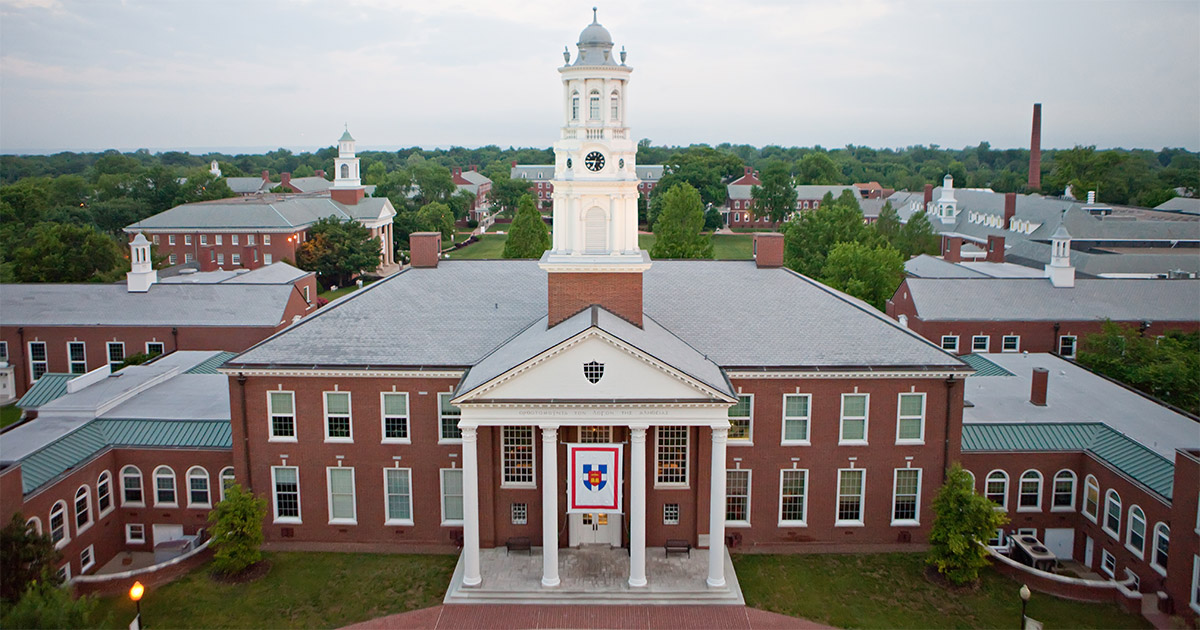
When I surrendered my life to God’s calling for vocational ministry at the age of 15, I always knew that that path would eventually take me to seminary, and now, as I am more than halfway through my PhD in Biblical Studies (New Testament) at The Southern Baptist Theological Seminary in Louisville, KY (pictured above), I can’t help but reflect on the value and benefits it has brought to my life and to my ministry. However, down here in the good ole’ “Bible Belt”, formal theological education is often viewed with a measure of skepticism and distrust. On the one hand, many people know faithful pastors who have influenced their lives who have never gone to seminary. On other hand, there is a lingering suspicion of academia that is left over from the historical influence of the Fundamentalist movement. So, it is understandable that in many churches, formal theological education can feel unnecessary at best and spiritually dangerous at worst. However, the real question is not simply whether theological education is necessary, but what kind of formation is required to faithfully know, teach, and live the truth of Scripture. Therefore, it is the thesis of this post that while formal theological education is not strictly necessary for faithful ministry, it is profoundly valuable because it cultivates the habits of careful thinking, deep reading, and disciplined reflection on the things of God.
Those who are leery of formal theological education point to several reasons why seminary is sometimes less than helpful. Some suggest that going to seminary kills spiritual passion, that academic theological knowledge can choke out personal devotion and piety. Seminary becomes a cemetery. And let’s be honest, this can happen. There is a real temptation in academia that one’s experience of faith can become utterly cerebral and lacking in spiritual pathos. However, I would suggest that this temptation is not unique to the seminary setting, and that it has more to do with the student than with the institution. Another objection that is sometimes heard is that “all we need is the Bible and the Spirit,” that the Scriptures are sufficient, and that the Spirit leads us into all truth. I have addressed this question in another post, but suffice it to say here that we do not download biblical understanding from the Spirit. His work has more to do with confirming and applying the truths of Scripture in our lives than with the transmission of content. Interpretation still requires care and study. Some also object that education can lead to pride and liberalism, and here again, these are legitimate concerns. And while discernment must be exercised in selecting an institution, it is up to the student to maintain their own humility and faithfulness. Lastly, as mentioned above, scores of pastors throughout the history of the church have served faithfully without formal theological training, and I praise God for those individuals. Let me say it clearly: seminary is not necessary for pastoral faithfulness. It is not a matter of necessity, but a matter of wisdom. The concerns I’ve listed here are not imaginary; they reflect real temptations and dangers. But they are dangers of misuse, not arguments against the value of theological training itself.
So, in the interest of clarity, it is important at this point to distinguish what theological education is and what it is not. First, theological education is not mere information transfer; it is not primarily about the mastery of content, though that is certainly a component of it. The fact is that we live in an information age, and theological content is available at the click of a button. Of course, not all of it is of the same quality, but it is true that taking in theological content is easier today than it has ever been. There are literally tons of resources both digital and in print that are available to the pastor who wants to grow in theological knowledge. And pastors should be taking it in; they should read and read widely and deeply, but seminary is not just about the transfer of information. Secondly, it is not a substitute for a person’s spiritual or devotional life. This I think is the misconception that undergirds a lot of the objections mentioned above, namely that seminary cannot replace personal piety and devotion. It is not a substitute for prayer, for holiness, for obedience, or for involvement in the local church. These are vital for spiritual life, and seminaries are not primarily focused on training these personal disciplines. Seminary is focused training in how to read carefully, how to think clearly, and how to serve faithfully throughout the course of one’s life. It is not about knowing more things; it is about learning how to think rightly about God and his Word.
This is exactly the point, namely that the Scriptures require careful and attentive reading. We must be taught the importance of historical and literary context, of genre and authorial intent, of words and sentences and paragraphs and how they communicate textual meaning. Ideally, these hermeneutical principles are modeled in the pulpit and Sunday school classroom. However, mastery requires focused and intensive didactic formation, because it is this kind of training that guards us from interpretive error. We must be taught how to rightly divide the Word of truth, so that we do not misuse Scripture for our own aims and ends or read our assumptions back into the text. Understanding the literary and historical intricacies and complexities of the Bible keeps us from falling into the arrogance of overconfidence, where familiarity is mistaken for understanding. It forces us to slow down, to wrestle with difficult passages, and to recognize that Scripture does not always yield its meaning at a glance. And in this way, it teaches us the discipline of slowness, how to let the text speak on its own terms and to listen carefully rather than forcing quick conclusions. What I am saying is that formal theological training teaches us not just what the Bible says, but how to listen to it well—and that is a skill that serves both the church and the individual believer for a lifetime.
In addition to learning to read carefully, formal theological training also helps us to develop theological depth in our understanding of the Word. It helps us to see the whole Bible, to understand the metanarrative of Scripture, and to locate particular books and passages within that unfolding storyline. We learn to follow themes and their development through the canon, and we come to appreciate both the continuity and the discontinuity between the Testaments. In doing so, we begin to see that the Bible is not a loose collection of disconnected texts, but a unified and coherent witness to God’s redemptive work in history. We also develop a certain measure of doctrinal coherence, in that we begin to understand how themes and concepts relate to one another, and we avoid fragmented theological reflections that isolate passages from the larger framework of Scripture. Questions of Christology, salvation, covenant, and kingdom are no longer treated in isolation, but are understood in relation to the whole counsel of God. Formal theological training also helps us to learn from the history of the church; it teaches us to see tradition as a resource rather than as a threat. (On the Use and Benefit of Tradition, see here.) To put it rather bluntly, we are not the first to read the Bible, and we won’t be the last. thankfully, this is a gift, not a limitation. It is an invitation to listen, to learn, and to be shaped by the wisdom of those who have gone before us.
Lastly, formal theological education helps us to develop intellectual humility. It exposes us to the difficult questions of the faith that have been asked throughout church history, and it forces us to wrestle with issues that do not admit of easy or immediate answers. It requires us to read and engage hard texts, both biblical and extrabiblical, and it immerses us in the real debates that continue to shape theological reflection even today. In doing so, it helps us develop a rightly calibrated confidence, one that is rooted in strong convictions, yet carried with a softer ego. We come to see that clarity is often hard-won, and that many of the questions we face have been carefully considered by thoughtful believers long before us. And as a result, we learn not only how to argue well, but how to disagree well. This is perhaps one of the greatest challenges in our present moment, and formal theological training can teach us to treat our interlocutors with patience, precision, and grace, even when we disagree deeply. In other words, theological education does not simply make you smarter; it makes you more aware of your limits. It reveals our strengths, exposes our weaknesses, and teaches us to value the insights of others, even when they do not fully align with our own.
However, even with all these benefits, formal theological education has its limits and dangers, and it is important that we are clear on what they are. For one, seminary training cannot produce spiritual life. And while many schools are now attempting to incorporate more spiritual life components into their curricula, it will always be true that knowledge simply does not equal transformation. True transformation is a work of the Spirit in us, and it is up to each individual to work with the Spirit through the classic spiritual disciplines in order to experience transformation. (On the Spiritual Disciplines, see here.) Second, seminary education can foster pride. This is a real danger. As the Scriptures remind us, “Knowledge puffs up, but love builds up.” (1 Corinthians 8.1) This is an ever-present temptation for those who are well informed in the study of the Scriptures. And lastly, seminary education can drift from the primary importance of the local church. At present, there is an ever-growing movement to reconnect seminary education with the local church, and this is to be celebrated. But seminaries must always orient their purpose and mission toward the service of the church, because it is the church that is Christ’s bride. However, in all three of these, the problem is not theological education itself, but theological education disconnected from the life of the church and the work of the Spirit.
This is why it is so important that head, heart, and ministry remain inherently intertwined. Pastors must always make sure that their thinking about God and their love for God remain together. There should be no head/heart divisions, as though theological precision and spiritual devotion were somehow in competition with one another. Rather, careful thinking about God should deepen our love for him, and our love for him should drive us to think more carefully about his Word. Further, pastors must remember that we do theology for the sake of the church, not for publications, not for CV development, not for accolades or recognition. All theology must be oriented toward the teaching, preaching, and discipleship ministries of the local church. “For the Church” must be more than an institutional mantra or a tagline; it must be the driving motivation in all of our theological efforts. Theology that does not serve the church ultimately fails in its purpose. And finally, we must remember that theological education is primarily about formation and faithfulness. We are seeking to develop the knowledge, skills, and habits that will sustain long-term ministry stability, presentational clarity, and faithful endurance. The goal is not to produce scholars detached from the church, but servants equipped to build it up, men who can think clearly, love deeply, and labor faithfully for the good of God’s people.
In the end, we must say this carefully: formal theological education is not necessary, but it is wise. God has used, and will continue to use, many faithful pastors and teachers who have never set foot in a seminary classroom. Again, thank God for his grace in this! The power of ministry has never rested in credentials, but in the faithful proclamation of the Word and the work of the Spirit. And yet, when pursued rightly, theological education is a gift. It strengthens the church by equipping its leaders to handle Scripture with greater care, to think with greater clarity, and to teach with greater depth and precision. It forms habits that serve a lifetime of ministry, not just a moment of preparation. To study theology carefully is not to move away from God, but to learn how to think about him rightly. That is a task worthy of our best effort.

 Faith seeking Understanding