Tag Archives: Biblical Interpretation

On the New Testament Use of the Old Testament
One of the most fascinating areas of biblical scholarship concerns the New Testament’s use of the Old Testament. Anyone who has spent much time reading the New Testament has eventually encountered an Old Testament quotation whose interpretive logic does not seem immediately obvious. We turn back to the original passage, read it within its context, and find ourselves asking, “How did the New Testament author get that from this Old Testament passage?” Some quotations and allusions seem relatively straightforward, while others, such as Matthew’s appeal to Hosea 11:1, initially appear somewhat disconnected from their original contexts. This raises an important hermeneutical question: If Scripture is inspired and authorial intent matters, are the apostles sometimes interpreting Scripture in ways that disregard what the Old Testament authors actually meant? Two possible answers present themselves. On the one hand, we might conclude that the apostles were not constrained by original meaning and therefore neither should we be. On the other hand, we might insist that every New Testament application must have been completely explicit within the conscious intention of the Old Testament author. Yet neither extreme adequately explains the phenomenon, because both fail to reckon with the way Scripture develops across redemptive history. Therefore, it is the thesis of this post that the New Testament authors do not abandon the original meaning of the Old Testament when they interpret it in light of Christ; rather, they read individual texts within their historical contexts and within the larger, progressively unfolding story of redemption that reaches its culmination in Christ.
Of course, before considering how the apostles read the Old Testament Christologically, we must first affirm that the original meaning of the Old Testament text actually matters. This is a fundamental principle of faithful biblical hermeneutics. The biblical authors used particular words within particular literary contexts, during particular historical circumstances, and for particular audiences. Therefore, interpretation must begin by asking what the inspired human author intended to communicate. This being the case, whatever Christological interpretation might subsequently emerge cannot be built upon the abandonment of authorial intent. However, it is also true that a text’s original meaning does not necessarily exhaust its canonical significance. An Old Testament author can communicate something real and intelligible within his own historical setting while his words simultaneously occupy a place within a larger story whose full significance unfolds over time. This is possible because the biblical authors do not write in isolation; each writes at a particular point within the progressively unfolding history of God’s redemptive purposes. Later revelation can therefore develop the implications of earlier revelation without contradicting what the earlier author actually meant. Or, to put it somewhat differently, the original meaning of a text establishes the necessary foundation for its canonical development, but it does not necessarily exhaust the significance that text possesses within the completed story of Scripture.
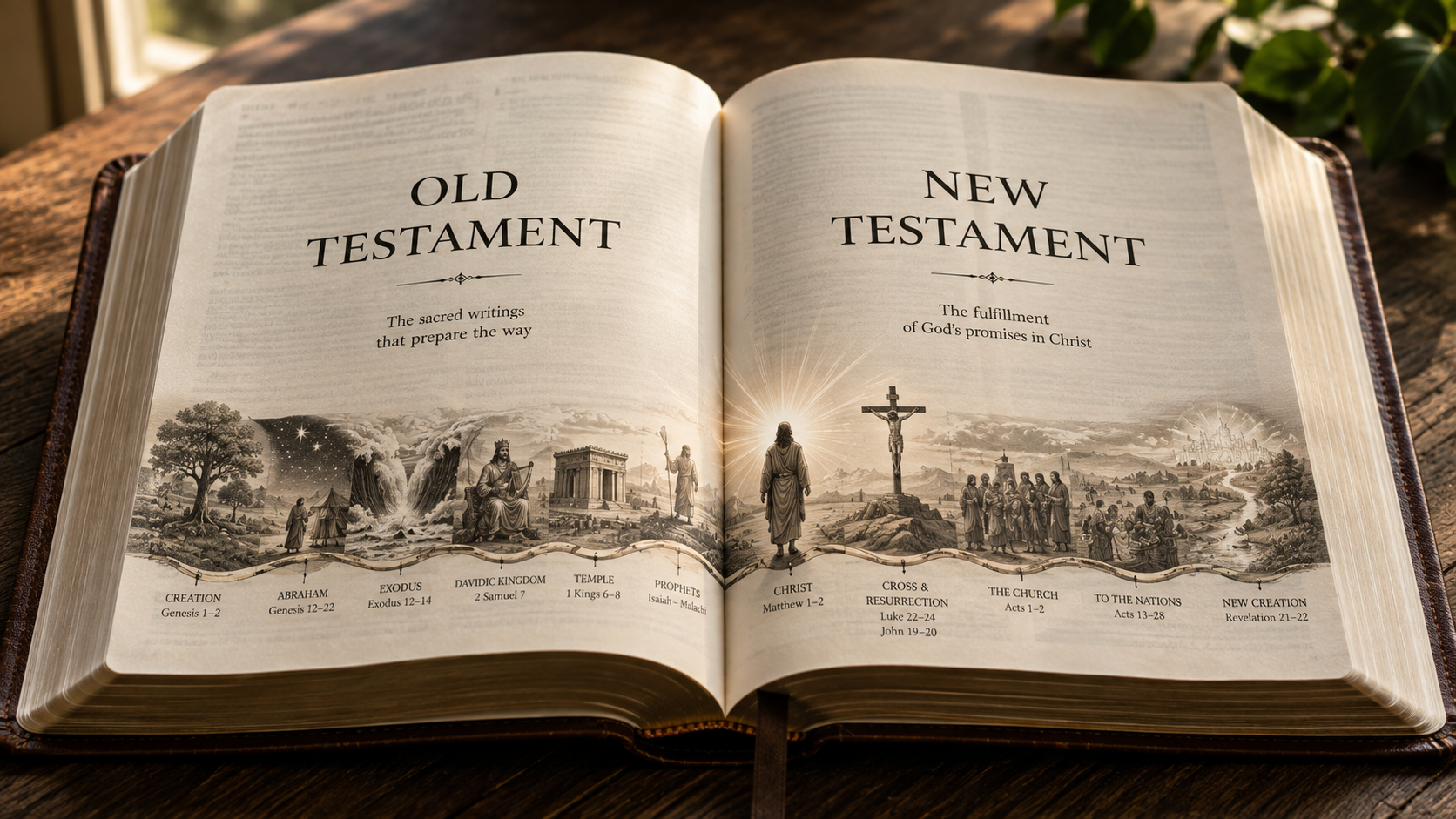
The reason this distinction is so important is that the Bible is not merely a collection of independent books; it tells one progressively unfolding redemptive story, i.e. creation, fall, redemption, and consummation. This is the metanarrative of Scripture. Throughout that narrative, several important themes and patterns rise to the surface—seed, covenant, exodus, sacrifice, temple, Davidic kingship, servant, restoration, kingdom, and new creation. These themes do not remain static but develop and become increasingly clear as God’s purposes unfold across redemptive history. The promise of the seed develops into the expectation of a coming Messiah; the Davidic covenant generates hope for an everlasting king; exile gives rise to the expectation of restoration; and the prophetic hope ultimately looks toward the renewal of creation itself. The New Testament authors inherit all of this as part of their own theological and canonical heritage. Therefore, although every Old Testament passage possesses an immediate historical-literary context, it also occupies a position within an unfolding redemptive-historical context. We call this progressive revelation, or the idea that God’s revelation of himself and of his plan to redeem humanity becomes increasingly clear as the story progresses. Later revelation clarifies and develops earlier revelation without contradicting it. Consequently, later biblical writers can recognize relationships, patterns, and implications that become clearer as God’s plan unfolds. In other words, the coming of Christ does not change the Old Testament’s story; it reveals where that story was ultimately going. And this is precisely how Jesus himself teaches his disciples to understand Israel’s Scriptures.
In Luke 24.44, Jesus tells his disciples that “everything written about me in the Law of Moses, the Prophets, and the Psalms must be fulfilled” (cf. Luke 24.26–27). In other words, Jesus teaches his disciples to interpret the Old Testament in light of his suffering, resurrection, and the proclamation of repentance to the nations. This does not necessarily mean that every individual passage of the Old Testament is a direct prediction concerning Jesus. Rather, the persons, promises, patterns, institutions, offices, expectations, and trajectories that develop throughout Israel’s Scriptures ultimately find their fulfillment in him. The hope for a Davidic king is fulfilled in Christ. The prophetic expectation of the servant of the Lord reaches its culmination in Christ. The Old Testament sacrificial system anticipates the sacrifice of Christ. The hope for Israel’s restoration reaches its fulfillment in and through Christ. Indeed, Jesus himself says, “Don’t think that I came to abolish the Law or the Prophets. I did not come to abolish but to fulfill” (Matt. 5:17). Fulfillment, therefore, is much broader than the correspondence between a direct prediction and a subsequent event; it encompasses the bringing of God’s entire redemptive purpose to its intended goal. The point is that Christ is not artificially inserted into Israel’s Scriptures; he stands at the culmination of the redemptive story those Scriptures themselves tell.
This is why the assumption that every New Testament quotation works in exactly the same way is problematic. The New Testament certainly employs the Old Testament through direct prediction and fulfillment, but it also utilizes typology, analogy, and broader biblical-theological patterns, often communicating these relationships through explicit quotation or more subtle allusion. For example, in Matthew 2:6, Matthew appeals to Micah 5:2 by way of direct prediction, but only a few verses later, in Matthew 2:15, he appeals to Hosea 11:1 by way of typology. Hosea speaks historically about Israel’s exodus from Egypt; Matthew recognizes that Israel’s sonship establishes a pattern that is recapitulated by Jesus, the true Son. (For more on this particular text, see my post “On Hosea, Matthew, and Authorial Intent,” here.) The same phenomenon occurs throughout the New Testament. Adam is a type of Christ; the Passover anticipates the atoning work of Christ; Davidic kingship reaches its fulfillment in Christ; and the tabernacle and temple anticipate God’s presence with his people ultimately realized in Christ. In each case, the relationship between the Old and New Testaments is real, but it does not operate according to precisely the same hermeneutical mechanism. In other words, fulfillment is a broader category than mere prediction. The New Testament does not require every Old Testament passage applied to Christ to have originally functioned as a direct messianic prophecy. Rather, Christ fulfills the persons, events, institutions, promises, and patterns that together constitute the unfolding story of redemption.
The New Testament authors can recognize a fuller significance in Old Testament passages without assigning them arbitrary meanings. Their readings are constrained by the original historical-literary context, the broader canonical context, the unfolding history of redemption, and ultimately the fulfillment of God’s purposes in Christ. They do not simply disregard the original meaning of a text and assign it an entirely new Christian meaning; neither are they limited to saying only what was already completely explicit within the conscious understanding of the Old Testament author. Rather, God’s intention as the divine author can encompass the developing significance of a text without contradicting what the human author actually communicated. The intentions of the divine and human authors must therefore be understood as complementary rather than competing. (On the question of inspiration and authorial intent, see my post here.) Whatever “fuller sense” we recognize in an Old Testament text must remain grounded in the inspired meaning communicated through the human author and develop organically from the place that text occupies within the unfolding story of redemption. This is because later revelation develops and clarifies earlier revelation; it does not overturn it. The New Testament’s Christological interpretation of the Old Testament is therefore not an alternative to grammatical-historical interpretation, but the canonical culmination of it.
So, when we encounter an Old Testament quotation in the New Testament and find ourselves asking, “How did the New Testament author get that from this Old Testament passage?” the answer is not that the apostles interpreted Scripture arbitrarily or disregarded its original historical and literary context. Neither is it that every Old Testament passage they employ was originally intended as a direct prediction of Jesus. Rather, the apostles read Israel’s Scriptures within their historical and literary contexts, while also recognizing their place within the broader canonical context and the unfolding story of redemption that has reached its culmination in Christ. Their example, therefore, does not give us permission to engage in imaginative interpretations disconnected from authorial intent. If anything, it requires us to read the Old Testament more carefully, tracing the promises, patterns, institutions, and theological trajectories that develop throughout the biblical story. The New Testament authors do not teach us to read Christ into the Old Testament where he does not belong. They teach us to read the Old Testament as Christian Scripture, recognizing that the same God who spoke through Israel’s Scriptures has brought the redemptive purposes revealed in those Scriptures to their divinely intended fulfillment in his Son. Original meaning and Christological fulfillment are not competitors; properly understood, the former provides the foundation upon which the latter is built.


