In the Sunday School class that I am a part of, we have recently been studying the history and meaning of the cross, and as a part of that study, I suggested that while the historical specifics and the theological significance of the cross are important, to truly understand the cross, we must understand it narratively as the climax of the Passion of our Lord and Savior Jesus Christ. This led the class’s facilitator to ask me to walk us through the Passion narrative, an invitation that I was more than willing to accept, and so, for more than two months, we followed in the steps of Jesus as He made his way toward the cross. And we did this by focusing specifically on Mark’s version of these events, which is recorded in chapters 11-16 of his Gospel.
It has been said that Mark’s Gospel is simply a “passion narrative with an extended introduction.” And whether that is an accurate description or not, Mark does allocate a disproportionate amount of space to the final week of Jesus’ life as compared with the first three plus years of His public ministry or, even, the thirty-some years that Jesus had lived beforehand. To be specific, Mark dedicates six entire chapters of his Gospel, some 38% if you are doing the math, to the events leading up and following Jesus’ death on the cross. Obviously, he thought that these events were of supreme significance. And so, typical of Mark’s style, these final six chapters tell the story of Jesus’ passion with such action and drama as to constantly leave the reader on the edge of their seat waiting to see what might happen next.
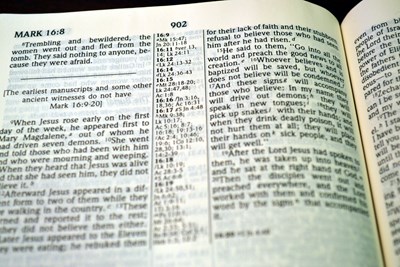
However, all throughout this study of Jesus’ passion week, I found myself feeling somewhat more afraid with every step we took as we moved closer and closer to the ending of Mark’s Gospel. You see, I already knew that there is a text critical question regarding Mark’s Ending, but the vast majority of the members of the class, being King James faithful, were very likely unaware of this issue. I was terrified of how they might react when I explained that Mark, chapter 16, verses 9-20, as they appear in their Bibles, are most likely secondary in nature. Well, I am glad to report that my brothers and sisters in Christ were more than gracious in accepting my explanation of the issue, which, as I had presumed, most of them had never been exposed to. But, the vast ignorance of this issue among so many Christians, especially down here in the Bible Belt, breaks my heart, so in the space that follows I would like to give a brief overview of the issues related to Mark’s ending(s).
The fact of the matter is that there are actually four endings to the Gospel of Mark which are extant in the manuscript tradition. They are as follows:
- No ending, as is indicated in most modern translations, the earliest and most reliable manuscripts, particularly B and א, end the text of the second Gospel at verse 8.
- The Short Ending, immediately following 16:8, “But they reported briefly to Peter and those with him all that they had been told. And after these things Jesus himself sent out through them, from east to west, the sacred and imperishable proclamation of eternal salvation.”
- The Long ending (otherwise known as 16:9-20), which is included in all Bible translations that are available today, though usually with brackets, footnotes, and/or other indicators of its questionable authenticity.
- The Expanded ending, which expands the Long ending after verse 14, saying, “This age of lawlessness and unbelief is under Satan, who does not allow the truth and power of God to prevail over the unclean things of the spirits [or, does not allow what lies under the unclean spirits to understand the truth and power of God]. Therefore reveal your righteousness now’ – thus they spoke to Christ. And Christ replied to them, ‘The term of years of Satan’s power has been fulfilled, but other terrible things draw near. And for those who have sinned I was handed over to death, that they may return to the truth and sin no more, in order that they may inherit the spiritual and incorruptible glory of righteousness that is in heaven.”
Now, I am not here to argue the merits for or against any particular one of these four endings, but suffice it to say that the overwhelming consensus of New Testament textual scholarship has concluded that all of the endings that we have (numbers 2-4 above) are inherently secondary, and that, whether intentionally or unintentionally, the Gospel of Mark as we know it ends at 16:8. Based on both external and internal evidence considerations, this much seems reasonably certain.
However, what is important is not one’s conclusion regarding the original ending of the Gospel of Mark, but what conclusions should be drawn in light of the textual question. First, we must maintain our belief in the fundamental trustworthiness and historical reliability of the Bible in general, and of the Gospel accounts in particular. Just because the last twelve verses of the second Gospel as we know it are in question, this does not mean that the rest of the Gospel of Mark, or the other three Gospels for that matter, are inherently false. In fact, all of the events in the so-called Long Ending are attested in the other accounts, especially in Luke and Acts. Further, we must remember that we do not build theological conclusions based on the testimony of one verse in isolation. As important as scriptural citations are in establishing the Biblical basis for our theological conclusions, individual verses must be understood within the context of the whole of Holy Scripture.
Second, this does not mean that translations of the Bible which lack any indication of the textual issue, e.g. some editions of the King James Version, are fundamentally in error, or that the are trying to lead people astray. The history of the Bible in English is long and complex, and conclusions that are based on the presence and/or omission of this particular issue, or others like it, are simplistic and reductionistic. To the extent that any English translation of the Bible faithfully reflects the original text of the autographs, then it can be read with great spiritual benefit. As Jesus promised, the Spirit will lead us into all truth through His Holy Word. Ultimately, He is the one who inspired the original biblical authors, He is the one who has providentially preserved the text, and He is the one who gives understanding of its truths and applies them to our hearts to make us more like Christ.


 Faith seeking Understanding