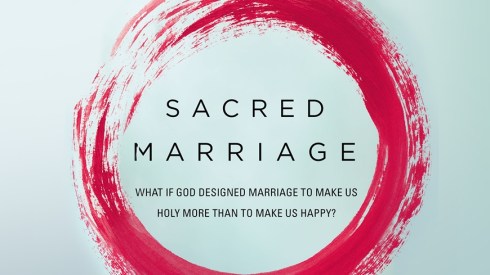
Thomas, Gary. Sacred Marriage: What if God Designed Marriage to Make Us Holy More Than to Make Us Happy. Grand Rapids, MI: Zondervan, 2015.
If you were to visit your local bookstore – who am I kidding? No one visit bookstores anymore, right?! So let me rephrase – If you were to google for books on marriage, you would probably find yourself overwhelmed by the sheer plethora of titles from both Christian and non-Christian perspectives offering this many steps or that new and unique approach to having a better a marriage. To be honest, it can almost lead to a feeling of despair and hopelessness for your marriage, especially if you find yourself in a particularly difficult season. That is why I found Sacred Marriage by Gary Thomas to be a refreshing and unique voice in this boisterous cacophony.
And the subtitle of the book really says it all: What if God designed marriage to makes us holy more than to make us happy? Because the general sentiment of popular culture is that marriage is primarily for emotional fulfillment. In other words, the main and most often the only reason a couple might get married is so that they can find and experience romantic love and personal happiness in their partner. Of course, on a horizontal level, that is alright, as far as it goes, but might it be possible that God has a bigger plan for marriage than simply our personal fulfillment, our happiness? Might it be that God designed marriage to serve His purposes rather than our own? And might it be that if we set our minds and hearts to pursue God’s purpose for our marriages, that we might find that our relationship with our spouse improves as well?
Obviously, I think so, and this is where Sacred Marriage comes into the discussion. In this book, Thomas explores the various aspects of the marriage relationship, not by offering any practical “how to’s”, but by exploring how God might be using that particular area of our marriage to teach us about who He is and to draw us into a deeper relationship with Himself. We may, then, regard marriage as a spiritual discipline, a Christian practice that by engaging in which we grow more and more in our own Christ-likeness, a posture of submission and humility in which we allow the Spirit who indwells to do His perfect work.Or we might say that God has so designed marriage that it, more than any other human relationship, forces us to deal directly with our own sinfulness.
The chapter that was most impactful for me was chapter 9, “Sacred Struggle: Embracing Difficulty in Order to Build Character.” The following quote summarizes the overall gist of the chapter:
If your marriage is tough, get down on your knees and thank God that he has given you an opportunity for unparalleled spiritual growth. You have the prime potential to excel in Christian character and obedience. (125)
Now, I want to be careful here, especially in light of what has recently transpired in the Southern Baptist Convention. In speaking of a tough or difficult marriage, we are not including here any kind of abuse, whether that be physical, sexual, emotional or verbal. All forms of spousal abuse are an evil and heinous sin in the eyes of God, and where there is violation of civil or criminal law, there should most certainly be consequences. And there is a great and pressing need for Christian churches to train people and implement processes to assist victims in these cases.
However, outside of those kinds of situations, difficult trying seasons in marriage are not cause for dissolution, which is precisely why we need a grander understanding of the purpose of marriage than mere emotional fulfillment. If marriage is only for the satisfaction of my need to be loved, accepted, and cherished, then when I no longer feel those needs are being met, I will find it justifiable to leave and seek out a new marriage that will meet those needs. But if marriage is for our sanctification, then difficulties in the marriage relationship can be embraced as opportunities to grow in Christ-likeness. In my opinion, this is a point of view that is sorely needed in today’s easy-divorce culture.
There were many other insightful and challenging aspects of this book, which is why I believe it’s voice is even more needed and applicable today than when it was first published nearly 20 years ago. For example chapter 10, “Falling Forward: Marriage Teaches Us to Forgive” was particularly helpful for me and my wife. As a pastor, I would certainly recommend this book to any all persons in my congregation regardless of what seasons they are in as it relates to marriage. For unmarried singles to dating/engaged couples to newly weds to those who find themselves in marriages of various lengths, whether you marriage is good or not so good, this book can definitely help shape your understanding of what God is doing in and through your marriage.
See Also:
Thomas, Gary. Devotions for a Sacred Marriage: A Year of Weekly Devotionals for Couples. Grand Rapids: MI: Zondervan, 2017.

 Faith seeking Understanding