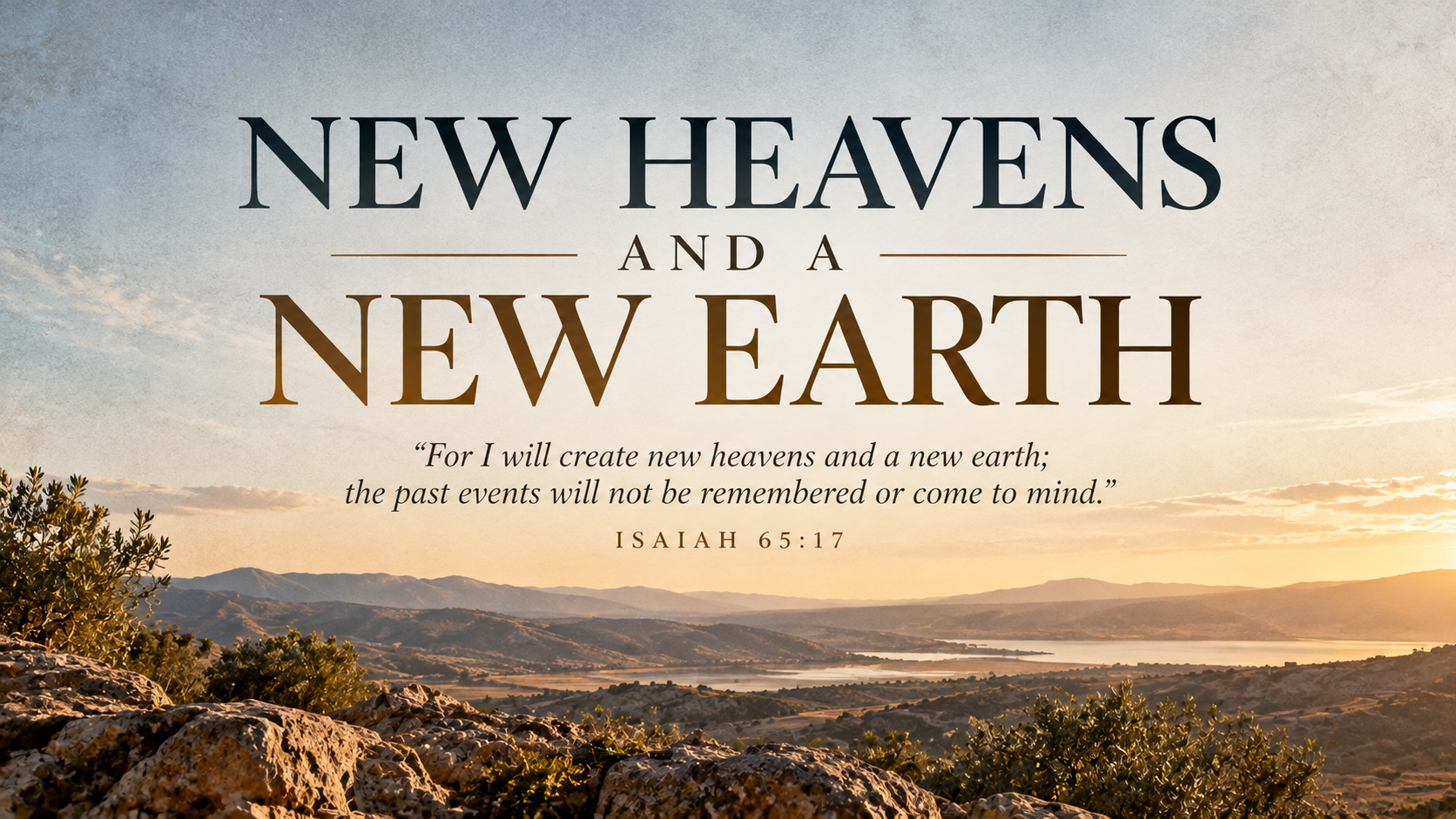
“Then I saw a new heaven and a new earth; for the first heaven and the first earth had passed away, and the sea was no more” (Rev 21:1). This is the ultimate hope of God’s people: that the cosmos itself will be renewed and there will be a new heaven and a new earth free from the corruption of sin and the curse of death. This is how the story of the Bible concludes, but it is not where the hope of new creation begins. That hope appears centuries earlier in the book of Isaiah. In Isaiah 65:17, we read, “For I will create new heavens and a new earth; the past events will not be remembered or come to mind.” In Isaiah’s eschatological vision, the redemptive plan of God climaxes in the creation of a new heaven and a new earth. And yet Isaiah apparently entertains the idea that death will continue. In verse 20, he speaks of someone who dies at one hundred being regarded as a young man. How can Isaiah describe the final new creation while apparently retaining features of the present age, including death? This is the question I would like to answer in this post. I will argue that Isaiah 65:17–25 portrays God’s eschatological salvation as a new creation in which the effects of the curse are comprehensively reversed and the covenant promises to Israel reach their climactic realization. Because Isaiah depicts this future through the concrete categories of Israel’s covenantal world, the presence of long life, offspring, houses, vineyards, and labor should not be read as evidence against a consummative new creation. Rather, these are the prophetic categories through which Isaiah describes the final restoration of God’s people and creation.
To understand this imagery, we must first recognize that the promise of a “new heavens and a new earth” does not appear out of nowhere. Throughout Isaiah, God’s eschatological promises move beyond the restoration of Israel toward the restoration of creation itself. This becomes particularly clear in Isaiah 24–27, sometimes called Isaiah’s “Little Apocalypse.” There, God’s final judgment assumes cosmic dimensions: the earth itself languishes under the effects of human rebellion (24:4–6), the LORD reigns gloriously from Zion (24:23), and the salvation that follows includes the remarkable promise that God “will destroy death forever” and “wipe away the tears from every face” (25:8). Isaiah even anticipates the resurrection of the dead: “Your dead will live; their bodies will rise” (26:19). The restoration envisioned in Isaiah 65–66 is the logical extension of this earlier eschatological vision. God does not merely promise to return Israel to the conditions that existed before exile. His restoration promises increasingly encompass the renewal of the created order itself. Isaiah 65:17–25 therefore brings Isaiah’s restoration hope toward its climactic expression. The God who restores his covenant people will ultimately restore the world in which his redeemed people dwell.
This cosmic dimension of Isaiah’s restoration hope is explicit in the opening words of the passage itself: “For I will create new heavens and a new earth” (Isa 65:17). The language is significant. God does not merely promise to repair what has been broken or return Israel to its former circumstances. He declares, “I will create.” The same God who brought the heavens and the earth into existence will act again in a way that transforms the created order. Indeed, the result will be so comprehensive that “the past events will not be remembered or come to mind” (65:17). Instead, God’s people are commanded to “rejoice and be glad forever” in what God is creating (65:18). Jerusalem, so often associated throughout Isaiah with judgment, destruction, and mourning, will itself become a joy, and God promises that “the sound of weeping and crying will no longer be heard in her” (65:19). Isaiah 66:22 confirms the enduring character of this promise when God speaks again of “the new heavens and the new earth” that he will make and which will “endure before me.” Isaiah’s restoration hope has therefore become new-creation hope. Its horizon extends beyond merely political restoration from exile toward an eschatological and creational transformation brought about by God’s own creative action.
And yet, having announced nothing less than the creation of “new heavens and a new earth,” Isaiah describes this future using surprisingly ordinary categories. No infant will live only a few days, and someone who dies at one hundred years old will be considered young (Isa 65:20). God’s people will build houses and actually live in them; they will plant vineyards and enjoy their fruit (65:21). They will not labor in vain or bear children destined for calamity, for they and their offspring will be blessed by the LORD (65:23). Why does Isaiah describe the new creation this way? The answer lies in Israel’s covenantal world. Long life, fruitful offspring, agricultural abundance, secure possession of the land, and the enjoyment of one’s labor are recognizable categories of covenant blessing. Conversely, the covenant curses threatened premature death, barrenness, dispossession, and the frustration of building houses or planting vineyards only for others to enjoy them (cf. Deut 28:30–33). Isaiah deliberately reverses these conditions. God’s people build and inhabit, plant and eat, bear children without calamity, and enjoy long and fruitful lives. Isaiah therefore describes the realities of new creation through the categories of covenant blessing because those categories provided Israel with its biblical vocabulary for imagining life fully restored under the blessing of God. The point is not to provide a literal demographic description of eternity, but to portray a world in which the covenant curse has been comprehensively reversed.
This covenantal framework also helps us understand the most difficult statement in the passage. Isaiah says that “the one who dies at a hundred years old will be mourned as a young man” (Isa 65:20). If this statement is read woodenly, then death apparently remains in the new creation. But within the imagery of the passage, Isaiah is taking the familiar covenant blessing of long life and stretching it toward its eschatological limit. The same pattern appears throughout the surrounding verses. Frustrated labor gives way to fruitful labor, dispossession gives way to the permanent enjoyment of houses and vineyards, and calamity gives way to security and blessing. By verse 25, the imagery expands beyond Israel’s covenant life to encompass creation itself: “The wolf and the lamb will feed together, and the lion will eat straw like cattle.” Echoing Isaiah 11:6–9, former hostility within creation has given way to peace, so that “they will not do what is evil or destroy” on God’s holy mountain. Even the statement that “the serpent’s food will be dust” recalls Genesis 3:14; while hostility within creation is overcome, the judgment pronounced upon the serpent remains. The movement of the passage is therefore not merely from shorter lives to longer ones, but from curse toward its comprehensive reversal. Isaiah is not giving us an actuarial table for the new creation; he is using the strongest categories of covenant blessing available to him to portray a world in which the curse has finally been overcome.
This interpretation becomes even clearer when we consider how Isaiah’s promise is received later in Scripture. When John sees the consummation of God’s redemptive plan, he deliberately takes up Isaiah’s language: “Then I saw a new heaven and a new earth” (Rev 21:1). He likewise draws upon Isaiah’s promise that weeping and crying will disappear, but now makes the implication explicit: God “will wipe away every tear from their eyes. Death will be no more” (21:4). Revelation 22:3 completes the picture: “there will no longer be any curse.” John does not abandon Isaiah’s vision but brings its eschatological trajectory into sharper focus. This is particularly important because some preterist interpretations appeal to the apparent continuation of death in Isaiah 65:20 to argue that the “new heavens and new earth” describe an intra-historical covenantal transformation rather than the final renewal of creation. Such readings correctly recognize something important: Isaiah’s new-creation language is thoroughly covenantal. But the mistake is not in recognizing the covenantal character of Isaiah’s new creation; it is in assuming that covenantal language and cosmic eschatology are mutually exclusive. Isaiah describes the latter through the categories of the former. Revelation confirms this trajectory by taking Isaiah’s covenantal vision of new creation and identifying its consummation with a world in which death and the curse themselves are finally no more.
How, then, can Isaiah speak of death within his vision of the “new heavens and a new earth”? The answer is that Isaiah communicates transcendent eschatological realities through the covenantal and creational categories provided by Israel’s Scriptures. Throughout Isaiah 65:17–25, everything that characterizes life under the curse is reversed. Judgment gives way to salvation, curse to blessing, premature death to abundant life, dispossession to secure inheritance, frustrated labor to fruitfulness, and hostility within creation to peace. Ultimately, the old creation gives way to the new creation. The apparent presence of death in verse 20 should therefore not be isolated from this larger movement and used to reduce Isaiah’s promise to an intra-historical covenantal transformation. Whatever fulfillments may occur within redemptive history, they cannot exhaust a promise whose biblical trajectory culminates in the abolition of death and the curse themselves. The Christian hope is therefore not simply for a better arrangement within the present world, nor merely for a new covenantal order in which the old has passed away. It is for the God who created the heavens and the earth to make all things new—to reverse the curse, abolish death, dwell with his people, and bring his purposes for creation to their appointed end.


