Tag Archives: Homiletics

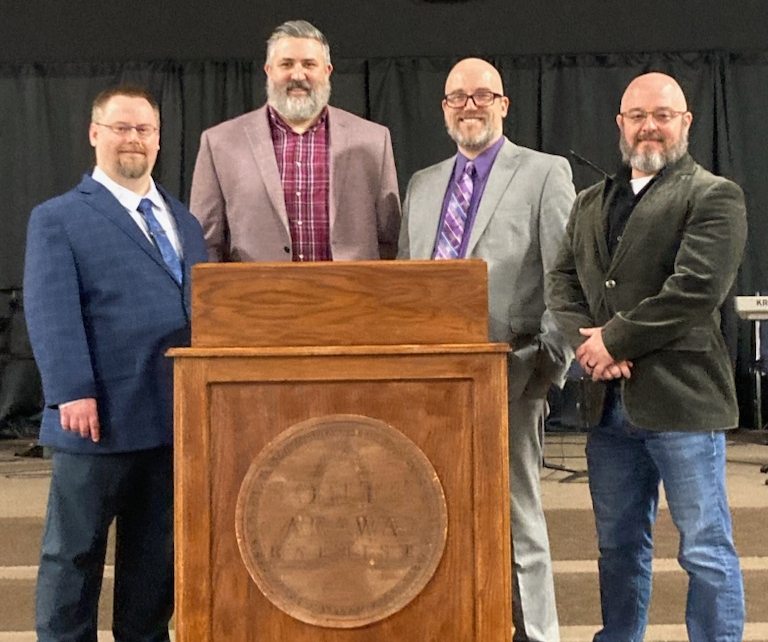
On a Vision for Cooperative Preaching Ministry

A well known seminary president recently tweeted, “Any consideration of Christian preaching must begin with the realization that preaching is essentially an act of worship—the central act of Christian worship.” Putting the possible overstatement aside, the preached word has been a staple of the church’s theological, doxological, and ethical life together since its very inception. Even today, in most churches, preaching occupies the primary place of emphasis and importance in the weekly worship gathering. However, more often than not, the priority of preaching in today’s churches has to do with the charisma and polish of the preacher rather than the authority of God’s Word. We have created a celebrity culture that platforms the personality of the most proficient speakers among us, so that the local church’s experience of the word of God revolves around the insight and understanding of one man.

However, if we believe that a plurality model is the most biblically consistent model for pastoral leadership in the church, then it necessarily follows that we should apply that model to the ministry of preaching as well. In other words, if the responsibilities and burdens of pastoral ministry are best shared among a band of brothers who are equal in position and authority, then the responsibility and burden of the word of God should be shared also. In the paragraphs that follow, I would like to highlight three ways in which a cooperative approach to preaching can benefit the local church, and then I would like to sketch briefly what this approach might look like practically.

The first way that this approach benefits the local church is that it nourishes the primary preaching pastor(s) by helping him to keep his spiritual tank full and avoid burnout. Week after week, the teaching pastor is responsible for feeding the flock; he is locked away in his study preparing lessons and bible studies and sermons. He is expected to give and give and give of himself, and when this continues without any respite, eventually his spiritual fuel tank will hit zero. Of course, most teaching pastors are glad to do this, but the question remains: who feeds the pastors? Shouldn’t the teaching pastor also be able to find spiritual nourishment within the local body of Christ as God intended, or must he resort to online preaching from pastors he admires but doesn’t know personally? A cooperative approach to teaching in the local church helps us to care for and sustain every part of our body, especially the pastors and teachers who faithfully sustain us. 

A second way this approach benefits the local church is that it provides the flock with a diversified diet of spiritual truth. Of course, God’s truth is absolute and unchanging, but it comes to us in vessels that are finite, broken, incomplete. No one has an exhaustive and complete understanding of everything in the Bible. No matter how much they might prepare and study, on this side of glory, their understanding of its truths will always be incomplete. Moreover, every minister of God’s Word comes to the text with different backgrounds, different experiences, different perspectives, and this is a good thing, because, as the Scriptures remind us, “iron sharpens iron” (Proverbs 27.17). There is nothing wrong with one pastor or elder holding the primary teaching responsibility, but it is good and healthy for the congregation to hear from other faithful voices from time to time. In this way, the congregation cultivates a complementary and more holistic understanding of the truth.

And lastly, the third way that a cooperative approach to pulpit ministry benefits the local church is that it accomplishes our commission. The Great Commission is to make disciples, and part of making disciples, as the Apostle Paul instructed Timothy in Second Timothy, chapter 2, verse 2, is committing to faithful men what we have heard who will then be able to teach others also. Local churches are called to train up the next generation of leaders, faithful men who can step into the pulpit and teach the Word of God faithfully. As pastors and elders, we must look forward to our succession. Who have we invested in that will be able to take up the baton of God’s Word when we are gone? A collaborative approach to teaching allows us to train and prepare faithful men, to give them the opportunity to stand before their spiritual family and teach the Word of God in the safety of a community that loves and supports them. 

In an ideal plurality situation, the primary preaching pastor should preach between 35 and 40 sermons annually; mathematically, this would come out to about three sermons per month. The remaining 15 or so can be equally shared among the other members of the elder team. However, a cooperative approach to the ministry of preaching goes beyond the allocation of Sundays. It should include discussion and planning of the direction for not only the series overall but of individual texts, and it should also include the opportunity for evaluation and feedback. Of course, this approach does not remove the individual pastor’s responsibility for textual work; every minister of the word must commit themselves to hard work of plumbing its depths. But it does mean that we are not alone in the process. As plurality of brothers, we come alongside each other in the ministry of the Word, so that we all can attain unto “maturity with a stature measured by Christ’s fullness.” (Ephesians 4.13)

This article is also posted at SBCvoices, here.


On Preaching and the Grotesque: A Book Review

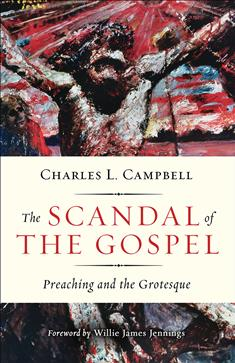
Campbell, Charles L. The Scandal of the Gospel: Preaching and the Grotesque. Louisville, KY: Westminster John Knox, 2021.

Painters have their colors and canvas, sculptors have their clay, and preachers have their words. And words are powerful. As the Bible so often indicates, words have the power to build up and to tear down, and this is especially so in the ministry of preaching, as Charles L. Campbell discusses in his latest book, The Scandal of the Gospel: Preaching and the Grotesque. Campbell is James T. and Alice Mead Cleland Professor Emeritus of Homiletics at Duke Divinity School. He is a past president of the Academy of Homiletics, a highly sought-after lecturer, and he is well published in the field.  Most of the content for this latest book comes from his 2018 Lyman Beecher Lectures at Yale Divinity School; only the fourth chapter contains new material.

In the forward, Campbell explains that he is not seeking any consistency or system; rather, he says that he is “simply trying to make some homiletical connections between preaching and the grotesque” (p. xiv). This concept of the grotesque subsequently stands at the center of the book. The term is borrowed from the world of visual art, where it originally referred to paintings found in ancient Roman grottos, i.e. grotto-esque. These “murals presented unsettling, disorienting hybrids that transgressed accepted categories. They distorted what was considered ‘normal’ or ‘beautiful.’ They messed with accepted patterns. They were, as they came to be called, ‘grotesque’” (p. 6). This description encapsulates the homiletical vision that Campbell sets forth in these chapters, i.e. preaching that is unsettling, disorienting, that transgresses accepted categories and norms, that is “grotesque.”

In the first chapter Campbell considers how this concept of the grotesque fits with the scandal of the Gospel. Taking his cue from 1 Corinthians 1:23, he explains that the Gospel confronts with the destabilizing pairings of opposites: God-cross, life-death, repulsion-fascination, horror-hope. A God that is violently crucified on a cruel Roman cross is inherently “grotesque.” In chapter 2, Campbell explores how the grotesque is often weaponized in the act of preaching. Specifically, when one compares sociological and/or theological opponents with non-human objects, one is using the grotesque to dehumanize and minimize them in order to maintain one’s own particular understanding of order. In chapter 3, Campbell offers an alternative to this kind of weaponization by explaining how the grotesque creates preaching that is “open, protruding, irregular, secreting, multiple, and changing” (p. 55). Preaching that is grotesque welcomes input and insights from a variety of voices, and not merely biblical and theological ones. It is preaching that “becomes real when truth happens among the cacophony and incongruities of diverse voices and diverse lives” (p. 57). Finally, in chapter 4, Campbell imagines how the grotesque could be employed in preaching to address the environmental crisis.

Campbell’s application of the grotesque to the discipline of preaching is provocative to say the least because it stands in such stark contrast to the kind of preaching that is the focus of Campbell’s critiques. Sermons that offer simplistic principles for improving marriage, managing finances, or raising godly children attempt to “give people a nice focused nugget to carry home – not the shocking unresolved contradictions of the grotesque gospel” (p.11).  This kind of preaching is neat, clean, even idealistic. The problem, however, is that “when we rush to order, when we avoid the interval of the grotesque, our preaching may become shallow, unreal, clichéd. We don’t go deep enough. We’re not honest enough. And we end up falsifying both the gospel and life itself – we end up imposing false patterns” (p. 12). Life is so often the opposite of the neat and clean categories we attempt to impose on it from the pulpit. It is complex and messy; it is “grotesque.” Campbell would have readers embrace these tensions rather than attempting to resolve them.

Though he rightly critiques this “humanistic” (his label) approach to preaching, the alternative that he proposes is inherently more so. Grotesque preaching is “shaped by the dynamic and open life of Jesus’ grotesque body. Grotesque preaching calls the church to be open to the world and calls the pulpit to be open to different bodies and new voices” (p. 56). It springs forth from the lived experiences of people rather than from the authoritative Word of God. What is glaringly absent from Campbell’s vision for preaching is how it relates to the principle of “Thus saith the Lord.” Christian preaching springs forth from the fact that God has spoken. The Apostle Paul instructed his protégé Timothy to “Preach the Word” (2 Timothy 4.2). God has spoken; therefore, we speak. In other words, the purpose of Christian preaching is to exposit the declared Word, “giving the meaning so that the people could understand what was read” (Nehemiah 8.8). It is not merely to listen to people’s stories or to appreciate the diversities and complexities of the human experience.

In the final analysis, Campbell’s invitation for preachers to approach the complexities, difficulties, and tensions of life with greater compassion is a welcomed alternative to the idealistic naiveté that characterizes most preaching today. That being said, his alternative is essentially void of the very resources that God has provided to address those complexities and difficulties. In other words, grotesque preaching, as Campbell envisions it, comes off merely as a way to exalt and platform human experiences over the Word of God. However, it is ultimately powerless as a homiletical method for proclaiming the inspired Word of the one true and living God. In my view, preachers would be better served by attending to the text of Holy Scripture, giving its meaning through systematic exposition, than by any clever attempts to be “grotesque.”

This Book Review was originally published in the Journal of Biblical and Theological Studies, here.


Slow To Write

"let every person be quick to hear, slow to speak, slow to anger."

lovegavehope

Just another WordPress.com site

Jared Cornutt

Pastor | Speaker | Writer

Denny Burk

A commentary on theology, politics, and culture

G3 Ministries

Events + Resources for the Local Church

Biblical Reasoning

Biblical and Systematic Theology According to the Scriptures

RetroChristianity

Reclaiming the Forgotten Faith

SBC Voices

Southern Baptist News & Opinion

Lucid Theology

Thoughts on words, books, theology, and life.

Baptist21

A pastor-led voice for Baptists in the 21st century

Center For Baptist Renewal

The Personal and Professional Blog of Phillip Powers

The Pastor's Well - Pastor Well

The Personal and Professional Blog of Phillip Powers

Articles - AlbertMohler.com

The Personal and Professional Blog of Phillip Powers

The Gospel Coalition

The Personal and Professional Blog of Phillip Powers