Author Archives: Phillip Powers

About Phillip Powers

Unknown's avatar
For to me, living is Christ and dying is gain. ~Philippians 1:21

On the Lack of Deep Biblical Preaching in the Church Today

teaching_preaching_church_teachers

When I was in seminary, it was pretty commonplace to hear my fellow classmates lamenting the lack of deep biblical preaching in churches today. These were pastors, teachers, and missionaries in training, and, certainly, their passion for the preaching office in the church is to be lauded. However, I think that in our zeal for deep preaching, it would be easy to develop an overly critical attitude when listening to sermons being preached. Nevertheless, as listeners, we must be discerning of what we hear. The difficulty is that the very concept of deep preaching is somewhat nebulous. What makes a particular sermon deep? What are the defining characteristics of a deep sermon? It is probably easier to define what deep preaching is not as opposed to what it is, so in that regard, what follows are some guidelines for identifying what deep preaching is not.

Deep preaching is not a seminary lecture. Preaching is not the time for an information dump of all that a preacher knows about a given passage. A seminary lecture has as its primary purpose to educate and to inform, and it is set in a classroom setting that is focused primarily on learning. Now, while these purposes certainly overlap with that of a sermon, they are still two quite distinct entities. A sermon must be catered to the audience and context for which it is intended, and it must be more than the dissemination of information.

Deep preaching is not a lesson in Greek or Hebrew. Studying the original languages of Holy Scripture is certainly a valuable, and I think it is a necessary resource for sharpening a pastor’s understanding of a given passage. But the pulpit is not the place to be giving vocabulary lessons. Use the original languages to inform your study, but then translate that meaning into the sermon in a way that people who have never been exposed to the original languages can understand. And don’t try to pronounce or include words from the original language in order to impress people with how much you know.

Deep preaching is not locked in the past. Here again, historical analysis and socio-cultural insights are important and helpful for understanding a given passage, and as those details serve to make the meaning of the text clearer, they can and should be included in the sermon to help listeners understand the text. However, a sermon that remains in the past and never brings the meaning forward to the present is not deep. It is merely a history lesson.

Deep preaching is not unnecessarily complex. All of the above leads us to this, that deep preaching is not complex for the sake of being complex. Literary, linguistic, historical, and cultural details all must serve the ultimate purpose of making the meaning of the text clear. Certainly some passages and genres are more demanding than others making the various contextual details necessary, but, ultimately, everything that is said and done in a sermon must relate to overall meaning of the text and serve to make it clear.

Deep preaching is not interested in self help, nor does it seek to entertain. This is perhaps what my seminary peers were concerned with in their laments, but ultimately the purpose of a sermon is not to give helpful advice for life, to make people laugh or feel good about themselves or their lives. The purpose of a sermon is to present listeners with the risen Lord Jesus Christ, to point them to the Gospel and their need for a savior, and to be the avenue the Spirit uses to call people to repentance and faith.

Now, let me be clear, I love studying the literary/grammatical and historical sociocultural contexts of the Bible, but expository preaching must not content itself with what the Biblical authors once said. No, it must move forward to what the Spirit is saying. So, in that light, let us move on to what deep preaching is.

Deep preaching is focused on the text. Let the main thing be the main thing, and the main thing in preaching is the text of Holy Scripture. It is the text that is inspired by the Holy Spirit, it is the text that the Spirit uses to touch hearts and change lives, and it the text that ultimately holds up Jesus as the author and finisher of our faith. In the sermon, pastors should not be giving their opinions or addressing their favorite soapboxes or hobbyhorses or whatever may be the hot topic from the news cycle that week. As Paul told the young pastor Timothy, “Preach the Word!” (2 Tim. 4:2)

Deep preaching is geared toward life change. The Bible refers to it as edification, but all that really means is that preaching is for the purpose of making more faithful disciples of Jesus Christ. That should be the goal in all we do from pulpit to piano to parking lot, to equip people for living this thing called the Christian life. Ultimately, we know that true life change is brought about by the Spirit, and the Word is His sword. Preachers are the handles of that sword as they faithfully proclaim the Spirit inspired message of Holy Scripture week in and week out, so that the Spirit can do His work of transforming sinful human beings into the image of Jesus Christ.

Deep preaching comes from a place of personal conviction. If a pastor has not been personally touched, convicted, comforted, challenged, or changed by a particular passage or sermon, then he should not be preaching it. This means that in addition to historical and literary study of the text, the preacher should be spending time in those classic word centered spiritual disciplines, i.e. meditation, prayer, and fasting, so that the truth of the Scripture is burned into his very soul. Preaching from a place of Spirit led conviction yields spiritual power, authenticity, and real life to the sermon being preached. If you want your listeners to be changed by the sermon you are preaching, then you had better be changed by it too.

See also Edwards, J. Kent. Deep Preaching: Creating Sermons that Go Beyond the Superficial. Nashville, Tenn.: B&H Academic, 2009.

On the Use and Benefit of the Lectionary

lectionary

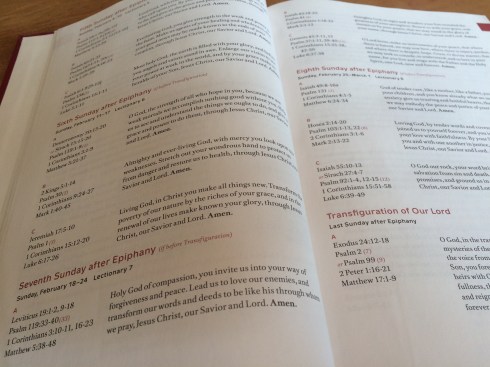
I have recently begun using the lectionary as the basis for my Sunday morning sermons. Now, this is a practice that is quite alien to most of the non-liturgical free church origin churches here in the “Bible Belt”. However, I can report that the reception of this practice has been quite positive.

For those who do not know, a lectionary is simply a weekly schedule of scripture readings that takes us through the entire text of the Bible once every three years, and the way it does this is by assigning four scripture readings per week that are then read aloud during weekly community worship gatherings. These four passages always include an Old Testament passage, a Psalm, and New Testament passage from Acts through Revelation, and a Gospel passage.

The following are some reasons I find this practice beneficial and useful::

  1. The Public Reading of Scripture – Paul gives clear instruction to Timothy for his ministry in Ephesus, saying, “Until I come, give attention to the public reading of scripture, to exhortation, to teaching.” (1 Timothy 4:13 NET) The corresponding note on that verse gives the following explanation:

    tn Grk “reading” sn The public reading of scripture refers to reading the scripture out loud in the church services. In a context where many were illiterate and few could afford private copies of scripture, such public reading was especially important.

    Even though the modern context is no longer challenged by the problem of illiteracy and practically everyone has their own private copy of the Holy Scriptures, Paul’s instruction is nevertheless pressing for churches today. More often than not, the only scripture that is read out loud during a worship service is that which pertains to the pastor’s sermon. So, in total, congregants are exposed to only a handful of verses, a minimal amount of God’s word, week after week. However, by following a lectionary, the congregation is exposed to larger chunks of Holy Scripture from a variety of books, authors, and genres. When these larger pericopes are read out loud every week after week during community worship, it guarantees that the church’s corporate life together is being shaped and molded by the Scriptures themselves.

  2. Biblical Literacy and the Metanarrative of Scripture – Now, as I stated, our modern culture is no longer challenged by the problem of illiteracy, but our churches are filled with people who are biblically illiterate, people who are mostly unfamiliar with the warp and woof of the Bible’s story, who cannot identify the important people and major events in salvation history, who do not understand the Bible’s major themes, big ideas, and central emphases. When we read out loud every week from an Old Testament passage, a Psalm, a New Testament passage from Acts-Revelation, and a Gospel, we are helping our congregations get a grasp of the metanarrative of Scripture, to see how the parts relate to the whole, to see how God’s plan for the salvation of His people runs through every book of the Bible.
  3. Relation to the Church Calendar – The lectionary schedule of readings typically follows the seasons of the church calendar, i.e. Advent, Christmas, Epiphany, Lent, Easter, Pentecost, Ordinary Time, and by doing so, it focuses our reflections on the life and ministry of our Lord Jesus Christ. So, instead of having to find a text to match a particular civil, cultural, or sentimental holiday, the texts of the lectionary center on the movements of the Gospel as we walk through the seasons of the church year. Every Sunday, the corresponding texts from the lectionary drive us back into the Gospel story, and by doing this, they form our identity and self understanding, they form our community worship life together, and they form our sense of purpose and mission.
  4. Freedom from the Burden of Selecting Texts/Topics – Perhaps one of the most challenging burdens for pastors/teachers is the weekly question of what to teach for the upcoming week. Often, in spite of an already full schedule of meetings, appointments, planning, and programs, leaders have to try to carve out time for study, meditation, and writing, usually, 2-3 lessons per week. Now, of course, we certainly want to rely upon the guidance of the Spirit in this process, because it is His words that congregants need to hear. He is the one who convicts sin, calls people to salvation, changes hearts, etc. However, more often than not, pastors/teachers tend to gravitate toward passages they have already studied and/or preached, toward their preferred hobbyhorses or soapboxes, or toward passages that are fairly easy and straightforward. The lectionary can help pastors plan out their preaching schedules, and it can challenge them to preach on texts and/or topics that they otherwise wouldn’t necessarily address.

Of course, pastors have the freedom to preach from all the lectionary texts, just a few, or even just one. They also have the freedom to depart from the lectionary for purposes of sermons and lessons, if so led by the Spirit; still, the lectionary passages could be read out loud as a part of the larger worship experience. In the final analysis, we want to let the main thing be the main thing, and for Christians the main thing is the inspired Word of God. May it be central to all that we are and all that we do.


On the Spirit and the Word

Title: On the Spirit and the Word
Church: Redeemer Church, La Mirada, CA
Date: Pentecost Sunday, May 27, 2012


On Hermeneutics & Interpreting the Bible

I once heard a pastor say, “It doesn’t really matter what people think about the Bible.” He went on to explain that, in this statement, he is addressing a (mostly) “bible-belt phenomenon” in which people get together for informal Bible studies, “pool their collective ignorance”, and without any real authority on the matter claim “Well, I think the text means this or that.” He concludes that this practice reflects a break down of basic hermeneutical skills, because it empties the text of its objective meaning by making it dependent upon what a person brings to it.

Now, let me just say that I share this pastor’s concern. In our study of the Biblical text, we must give interpretive priority to the meaning that the original authors – both divine and human – intended in light of their historical and cultural context. However, it would be easy for someone with no seminary or bible college training to infer from this that it is impossible to really understand the Bible without the proper training in hermeneutics & Bible study methods. From this, they might even conclude that it is pointless to even read/study the Bible on their own or that they should really just leave study of the Bible to the “experts” (read scholars/pastors) who have been trained to do it. As the Apostle Paul would say, “May it never be!”

In other words, we must affirm, as one of our fundamental theological values, something called the perspicuity of Scripture. We must believe that the message of Holy Scripture is essentially clear and understandable to any and all who are willing to open its pages. Of course, this does not mean that every nuance is easily defined or that there are no obstacles to overcome in the interpretive process. However, it does mean that God has revealed himself in the Bible in a way that He meant for us to be able to understand.

Scripture can be and is read with profit, with appreciation and with transformative results. It is open and transparent to earnest readers; it is intelligible and comprehensible to attentive readers. Scripture itself is coherent and obvious. It is direct and unambiguous as written; what is written is sufficient. Scripture’s concern or focal point is readily presented as the redemptive story of God. It displays a progressively more specific identification of that story, culminating in the gospel of Jesus Christ. All this is to say: Scripture is clear about what it is about. (Callahan, The Clarity of Scripture, 9)

Secondly, as pastors and teachers, if we truly believe that a basic understanding of hermeneutical principles and bible study methods is necessary in the study of the bible – and it is – then we should include this as a foundational part of the teaching/preaching ministry of the church, both implicitly and explicitly. Implicitly, we must model good hermeneutics in the pulpit; yes, our lessons and sermons must serve as examples of how to study the Bible well. We must let principles like authorial intent, historical/cultural context, literary flow-of-thought, and the big idea guide us in our sermon/teaching preparation. We must give first priority to what the text says over our own thoughts (read soapboxes). On the other hand, explicitly, we should make it a goal to teach people how to study the Bible, both from the pulpit in a large gathering and in a small group setting. People need to understand the contours of the biblical genres, and they need to know how to evaluate and use the wide range of Bible study resources that are so readily available in today’s information culture. They could even stand to learn a little about the biblical languages and how they work. In other words, our goal in preaching and teaching should be to work ourselves out of a job, i.e. to teach people how to study and understand the Bible for themselves.

Lastly, we should trust the Holy Spirit. He is the one who inspired Holy Scripture, and He is the one who illuminates our minds to its truths. Moreover, He is the one who applies those truths in our lives to bring about radical lifechange. In other words, engaging in the study of the Bible without giving attention to the work of the Spirit can never be more than historical investigation, no matter how consistently the principles of hermeneutics are applied. We must remember that Bible study is one of the spiritual disciplines by which the Spirit makes us more like Christ, and He can be trusted to testify to the truth. (John 14:26, 15:26, 16:12-15) This does not negate the role of the preacher/Bible teacher, but it does move our dependency from fallible human beings to the Holy Spirit of God. He is the only infallible interpreter of Scripture.

Ultimately, hermeneutical considerations are a means to an end, and that end is a more accurate and clearer understanding the biblical text itself. Studying hermeneutics gives us the basic skills and tools to understand the Bible better, i.e. the way the original audience would have understood it, the way that the inspired authors intended for it to be understood. So, what we need to say is: “It doesn’t matter what people think; it matters what the text says!”


On Persistence in Prayer – Part 3

32948-kneeling-prayer-1200_1200w_tn.jpg

I have recently been considering Jesus’ teaching on the topic of prayer. In my last post in particular, I looked at Luke 11 and the parable of the friend at midnight, and I concluded that Jesus is calling us to a persistence in prayer that is general in scope, a persistence in the spiritual discipline of prayer, itself. Our Father is not the kind of God who needs to worn down, pestered, or annoyed into answering our prayers. He is an essentially good and trustworthy father who knows what His children need before we even ask him, and he delights in meeting the needs of his children.

Now, in chapter 18, just seven chapters later, Luke presents a parable that would seem to negate that very conclusion. In Luke 18:1, Luke states that “Now he told them a parable on the need for them to pray always and not give up,” and he goes on to relay the parable of the unjust judge in which a widow repeatedly goes before a local magistrate seeking justice against her “adversary.” Ultimately, the judge concludes that “because this widow keeps pestering me, I will give her justice, so that she doesn’t wear me out by her persistent coming.” (v5-6) If we assume that this parable relates to the practice of prayer in general, then we have no choice but to conclude that perhaps we need pester God into giving in to our requests.

This is exactly the assumption that we must reconsider in this passage: is Luke and, by way of implication, Jesus telling this parable to illustrate something about prayer in general? I think not.

Luke often arranges the teaching and parabolic material of Jesus topically, and he indicates the topic usually at the beginning of a new section. So, in Luke 17:20, Luke begins a new section about “when the kingdom of God would come,” and this section dealing with the coming of the kingdom begins in 17:20 and extends all the way until Luke 18:8. (Remember, Luke did not originally have chapter divisions). Then, in Luke 18:9, he begins a new section in which “He also told this parable to some who trusted in themselves that they were righteous and looked down on everyone else.” This informs us that Jesus is not addressing our practice of prayer in general, but he is addressing a very specific kind of prayer, i.e. the prayer for the coming of the kingdom.

Secondly, in order to understand the exact nature of the widow’s request, we have to see her in light of the first century world in which Jesus lived. In Jesus’ day, women were essentially powerless, and, if their husband died, then they were left without many options for survival. Most likely, this widow was not allowed to inherit her husband’s property. So, her only options were to remain with her husband’s family where she would probably be treated as a servant, or to return to her family and repay her dowry to her parents. If she could not do either of these, she would probably be sold as a slave for debt. She was faced with homelessness, poverty, and starvation. So, her request to the judge “give me justice against my adversary” is a once-in-a-lifetime request, it was unique to her situation, and it was not something she would repeat ever again. Her situation is desperate, and she is powerless to change it.

Lastly, just like in Luke 11, so here we must recognize that Jesus is using a rhetorical technique called “from the lesser to the greater”; he is making a “how much more” argument, and he is doing so by way of contrast and not comparison. It is patently obvious in this passage that we are not supposed to identify God with the unjust judge, since the passage tells us twice that he neither feared God nor respected men. The God of the Bible is fair, good, and just. He treats all people equally; He blesses those who call upon him in faith. No, God is not like the judge in this passage.

So, hear Jesus’ conclusion,

“Listen to what the unjust judge says. Will not God grant justice to his elect who cry out to him day and night? Will he delay in helping them? I tell you he will swiftly grant them justice.” (vv6-8)

In the final analysis, Jesus is teaching us to pray always as he taught us in The Lord’s Prayer, “May your kingdom come,” and not give up hope. He is coming soon. “Amen, come Lord Jesus!”


On Persistence in Prayer – Part 2

“Lord, teach us to pray.” (Luke 11:1) A seemingly simple question, but what is striking is that the disciples must have known how to pray. After all, they were raised in a Jewish religious system that placed a significant value on prayer. Nevertheless, when they compared their experience to that of Jesus, they couldn’t help but conclude that there must be something that they were missing out on in their practice of prayer.

And Jesus’ answer to the disciples’ question is the Lord’s prayer, a text that is probably not completely unfamiliar to most. (Luke 11:2-4) So, in lieu of an extended discussion on all the clauses of this “model prayer”, we may simply conclude that Jesus’ understanding of prayer was grounded in His relationship with the Father which He had by nature as the Son of God, and, in the gospel, that relationship is extended to us by grace through faith. We may now bring all of our needs and concerns to God in prayer, because He has become our Father and we have become His children. (On this, see my post: On the Lord’s Prayer)

Jesus’ answer to the disciples’ question, however, doesn’t simply stop with the model prayer. He goes on in this passage to describe what kind of a father God actually is, i.e. a good and trustworthy Father who responds to the requests of his children. This much is explicitly stated in Luke 11:11-13; this much seems reasonably clear. The difficulty, though, lies in between these two seemingly clear pieces of Jesus’ answer, and this being the “parable of the friend at midnight”. (Luke 11:5-8)

5 And he said to them, “Which of you who has a friend will go to him at midnight and say to him, ‘Friend, lend me three loaves, 6 for a friend of mine has arrived on a journey, and I have nothing to set before him’; 7 and he will answer from within, ‘Do not bother me; the door is now shut, and my children are with me in bed. I cannot get up and give you anything’? 8 I tell you, though he will not get up and give him anything because he is his friend, yet because of his impudence he will rise and give him whatever he needs. (ESV)

On a first reading, it might seem that Jesus is suggesting that, when we have a particular need or concern, we ought to persistently bring that request to God in prayer until He responds. After all, isn’t that what the friend in the parable had to do to get his neighbor to give in to his request? And doesn’t Jesus say that it is because of the friend’s persistence (cf. v8, so NASB, NET, NKJV, HCSB) that causes the neighbor to rise and respond to his request.

However, there are several exegetical and theological problems with this “persistence” interpretation

  1. In vv. 5-7, Jesus is asking a rhetorical question similar to the question he asks a little later in the same passage in vv. 11-12. In both places, the question is simply “would any of you do something like this?”, and in both places, the implied answer is “No!” Just as no father would give their child something that is harmful like a snake or a scorpion, no person in Jesus’ day would act like the friend in this parable.
  2. Jesus confirms this when he describes the friends actions as “impudence” (v.8, so ESV). Now, a quick survey of the major translations reveals quite a bit of diversity in the translation of this word even though, most translations opt for something like “persistence”. The problem is that this is the only occurrence of this Greek word in the entire NT, a hapax legomena, and when we look at the uses of this word outside of the NT, it is reasonably clear that it never means anything like persistence. It always carries a negative connotation of something like shamelessness, impertinence, impudence, ignoring of convention. It describes a lack of sensitivity to what is proper, or a carelessness about the good opinion of others (so BDAG).
  3. Lastly, Jesus is making an argument from the lesser to the greater, a how much more argument, and he is doing so by way of contrast and not comparison. In other words, if this sleeping neighbor will respond to the embarrassing, culturally inappropriate, shameless request of his friend, then how much more will God certainly respond to the appropriate and legitimate requests of His children. The parallel question in the passage, which we alluded to earlier (v. 11-13) drives this point home: God will certainly give His children good things when they ask Him.

For these reasons, it is unfortunate that translators and commentators continue to import the idea of persistence into this parable. Jesus is not calling us to be more persistent (read insistent) in our prayers; rather, he is calling us to grow in our faith and trust that God is a good father who responds to the needs of His children when they bring them to Him in prayer. If this is so then, one cannot help but wonder if there is not some other scriptural warrant upon which we might base a theology of persistence in prayer. In this regard, some turn to the “ask, seek, knock” saying in 11:9-10.

9 And I tell you, ask, and it will be given to you; seek, and you will find; knock, and it will be opened to you. 10 For everyone who asks receives, and the one who seeks finds, and to the one who knocks it will be opened.

The imperatives in this saying – ask! seek! knock! – are in the present tense, and in the original language, this usually refers to a continuous action. So, the HCSB translation “keep asking… keep searching… keep knocking” is not completely unwarranted. However, it would be wrong to conclude that repetition in asking, seeking, and knocking is what causes it to be given to or opened for us, especially in light of the preceding parable of the friend at midnight. In light of what we said there, it seems more likely that Jesus is saying that we should keep on asking, seeking, and knocking because we can trust God our Father to give and to open. In other words, the cause-effect relationship does not flow from prayers voiced to answers received, but the other way around. God’s fatherly goodness should motivate us to keep on asking, seeking, and knocking.

So, we may need to reconsider our definition of persistence in prayer. Most of the time, when people think of persistence in prayer, they think of the repetitive bringing of the same request over and over to God until He gives us an answer. However, this definition simply doesn’t reflect what Jesus is teaching in this passage. Further, the path between this kind of “persistence” and sinful insistence would seem to be quite slippery indeed. No, I think Jesus is envisioning a different kind of persistence – one that is more general in its scope, one that is grounded in faithfulness to the spiritual discipline of prayer itself, one that is motivated by our fundamental belief in God’s Fatherly goodness. In other words, Jesus is calling us to a persistence that is characterized by the regular bringing of all our requests to God in prayer, always trusting in Him to respond to our needs as a Father.

For further study:

Sermon: Lord, Teach Us to Pray! (Luke 11:1-13)
Series: The Parables of Jesus
Church: Redeemer Church, La Mirada, CA
Date: June 19, 2011

See also Snodgrass, Klyne. Stories with Intent: A Comprehensive Guide to the Parables of Jesus. Grand Rapids, Mich.: Eerdmans, 2008.


On the Lord’s Prayer – Part 1

Title: How, then, should we pray? (Matt 6:9-15)
Series: Lord, Teach Us to Pray
Church: Wynne Baptist Church, Wynne, AR
Date: May 16, 2010


Slow To Write

"let every person be quick to hear, slow to speak, slow to anger."

lovegavehope

Just another WordPress.com site

Jared Cornutt

Pastor | Speaker | Writer

Denny Burk

A commentary on theology, politics, and culture

G3 Ministries

Events + Resources for the Local Church

Biblical Reasoning

Biblical and Systematic Theology According to the Scriptures

RetroChristianity

Reclaiming the Forgotten Faith

SBC Voices

Southern Baptist News & Opinion

Lucid Theology

Thoughts on words, books, theology, and life.

Baptist21

A pastor-led voice for Baptists in the 21st century

Center For Baptist Renewal

The Personal and Professional Blog of Phillip Powers

The Pastor's Well - Pastor Well

The Personal and Professional Blog of Phillip Powers

Articles - AlbertMohler.com

The Personal and Professional Blog of Phillip Powers

The Gospel Coalition

The Personal and Professional Blog of Phillip Powers