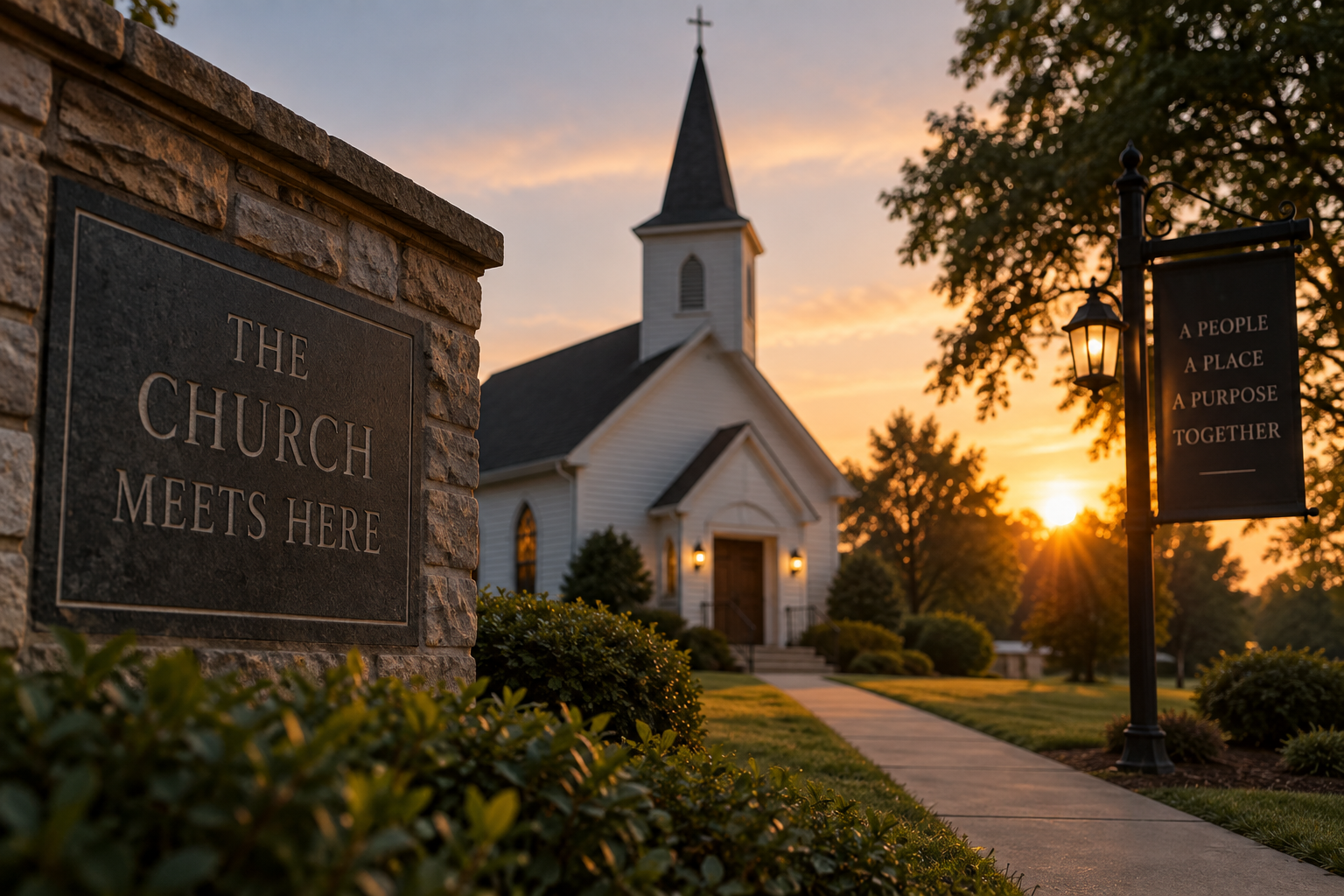
Paul Washer has been quoted as saying, “Don’t look for the church nearest to your house; look for the church closest to the Bible.” I understand the point, and there is considerable wisdom in it. Christians need faithful, Bible-believing churches, and proximity can never compensate for serious theological or ecclesiological unfaithfulness. Yet I wonder whether, in emphasizing the first half of that equation, we have sometimes neglected the importance of the second. It has become increasingly normal for Christians to drive thirty, forty, or even fifty minutes to attend their preferred church, sometimes passing several faithful churches along the way. Of course, there may be good reasons for doing so. But the New Testament’s vision of the church is profoundly local. Churches are gathered in particular places, composed of people who worship together, bear one another’s burdens, submit to one another, serve one another, and bear witness to Christ within the communities where God has placed them. The local church is therefore more than a place where Christians receive good preaching on Sunday morning. It is a community in which they share the ordinary rhythms of Christian life. Perhaps, then, the question is not simply whether we have found a church faithful enough to attend, but whether we have planted our lives deeply enough within a local church to truly belong to one.
Part of the problem is that the modern world has accustomed us to living our lives across increasingly large geographical areas. We may live in one town, work in another, send our children to school in another, and regularly drive considerable distances for shopping, entertainment, and recreation. It is perhaps unsurprising, then, that we have begun to approach the church in much the same way. Rather than looking first for a faithful congregation within the community where we already live, we can survey churches across a wide area and choose according to our particular preferences: preaching style, music, children’s ministry, programs, demographics, theological distinctives, or any number of other considerations. None of these things is necessarily unimportant, and some may represent legitimate theological convictions rather than mere preferences. The danger comes when this way of choosing a church subtly transforms the congregation into another religious service that we consume. We drive somewhere on Sunday morning to receive the preaching, worship, and programming we prefer, and then drive back to a life that remains largely disconnected from the people with whom we have just worshiped. But a church is not merely a place where Christians gather for a few hours each week. It is a people to whom we belong. And if belonging to a church means sharing our lives with one another, then the distance between our church life and the rest of our life may matter more than we sometimes imagine.
This emphasis on belonging reflects the way the New Testament ordinarily speaks about the church. Certainly, there is a universal dimension to the church: Christ is building his church (Matt 16.18), and all who belong to him constitute his body. Yet this universal church repeatedly takes concrete expression in particular congregations located in particular places. We read of the church in Jerusalem (Acts 8.1), the church at Antioch (Acts 13.1), the church of God in Corinth (1 Cor 1.2), and the churches scattered throughout cities and regions across the Roman world. These were not merely collections of Christians who happened to attend the same worship service. They were identifiable communities of believers who knew one another, worshiped together, appointed and submitted to leaders, cared for members in need, practiced discipline, supported the work of the gospel, and shared responsibility for one another’s faithfulness. This is why Paul can describe the church as a body whose individual members belong to one another and depend upon one another for the health of the whole (1 Cor 12.12–27). The New Testament church is therefore universal in scope but irreducibly local in expression. Christianity does not merely unite individual believers to Christ; it joins believers to Christ’s people. And ordinarily, that belonging becomes visible not through an abstract relationship to Christians everywhere, but through committed participation in a particular congregation of Christians somewhere.
This local character of the church becomes especially important when we consider the numerous “one another” commands scattered throughout the New Testament. Christians are commanded to love one another (John 13.34), serve one another (Gal 5.13), bear one another’s burdens (Gal 6.2), encourage one another (1 Thess 5.11), confess their sins and pray for one another (Jas 5.16), show hospitality to one another (1 Pet 4.9), and teach and admonish one another (Col 3.16). These commands envision considerably more than occupying the same room for an hour or two on Sunday morning. They assume a shared life in which believers know one another well enough to recognize burdens, meet needs, offer encouragement, practice hospitality, and intervene when a brother or sister begins to wander. Of course, none of these commands establishes a geographical radius within which Christians must live, and modern transportation allows us to maintain relationships across distances that would have been unimaginable in the first century. Nevertheless, proximity ordinarily facilitates the kind of shared life these commands envision. It is much easier to bring a meal, open our homes, care for children, visit the sick, respond to an unexpected need, or simply participate in the ordinary rhythms of one another’s lives when the members of a church actually live near one another. The question, then, is not merely whether we can make the drive to church each Sunday, but whether we are close enough to its people to share our lives with them throughout the week.
The importance of this shared life becomes even clearer when we consider the means through which God ordinarily brings Christians to maturity. From the beginning, the church devoted itself to “the apostles’ teaching and the fellowship, to the breaking of bread and the prayers” (Acts 2.42). Christians grow through the preaching of the Word, prayer, baptism and the Lord’s Supper, fellowship, accountability, discipline, and the ordinary encouragement of other believers. Indeed, Paul describes the church as a body in which Christ gives pastors and teachers to equip the saints for ministry so that the entire body might grow together toward maturity in Christ (Eph 4.11–16). Christian growth is therefore not merely the result of receiving biblical information from a gifted preacher. It occurs as believers are joined to a community in which every member contributes to the spiritual health of the others. The same is true of pastoral ministry. Elders are not merely preachers whose sermons we consume each week; they are shepherds charged with keeping watch over particular souls for whom they will give an account (Heb 13.17). Such shepherding assumes that pastors know their people and that those people are sufficiently involved in the life of the congregation to be known. God certainly uses ministries beyond the local church for our good, but the ordinary pattern of the New Testament places our worship, discipleship, accountability, and perseverance within the life of a particular congregation.
There is also a missional dimension to the local character of the church. When God sent the exiles into Babylon, he instructed them to “seek the welfare of the city” where he had sent them (Jer 29.7). This passage is not, of course, a direct command concerning New Testament church membership, but it reflects a broader biblical principle that God’s people are called to live faithfully in the places where his providence has situated them. The church’s witness likewise occurs not merely in the abstract but in actual neighborhoods, towns, and cities where Christians live alongside unbelieving neighbors, coworkers, friends, and family members. Ideally, then, our church life and our community life should not exist in two entirely separate geographical worlds. When Christians worship, serve, and build relationships with believers who share the same communities in which they live, the church is better positioned to become a visible presence for the gospel within that place. Members can invite neighbors into relationships that naturally extend into the life of the congregation, churches can become more attentive to the needs of their communities, and evangelism can emerge from the ordinary relationships of everyday life. Again, none of this means that every Christian must attend the congregation geographically nearest to his or her home. But it does suggest that there is something valuable about churches that bloom where their members are planted: particular communities of Christians bearing witness to Christ together in the particular communities where God has placed them.
If the local church occupies this kind of place in the Christian life, then it should inevitably shape some of the larger decisions we make about where and how we live. Christians routinely make decisions about education, employment, housing, retirement, and relocation on the basis of numerous legitimate considerations: salary, cost of living, proximity to family, quality of schools, career opportunities, and countless others. Yet the local church can easily become an afterthought. We decide where we want to live and only afterward ask whether there happens to be a faithful church somewhere within driving distance. Perhaps we should reverse that order, or at least bring the church much earlier into the conversation. If God ordinarily intends Christians to grow, worship, serve, persevere, and participate in his mission through the life of a local congregation, then the availability of a faithful church should matter when deciding where we plant our lives. This does not mean that the church must always outweigh every other consideration, nor that Christians are wrong to accept jobs or pursue opportunities that require relocation. It simply means that belonging to Christ’s people should be treated as one of the defining priorities of the Christian life. Before asking only, “Where can I find the best job, house, or opportunity?” perhaps we should also be asking, “Where can I faithfully belong to Christ’s people and invest my life alongside them?”
None of this is intended to establish an arbitrary geographical rule for church membership. There are many legitimate reasons why Christians may need to travel some distance to belong to a faithful church. Those living in rural communities may have few healthy congregations nearby. Others may face significant theological disagreements with the churches closest to them, require a congregation that ministers in a particular language, or have family and ministry circumstances that make a more distant church the wisest choice. Churches themselves can change, decline, or depart from convictions that once made them faithful places to belong. Nor should proximity ever be used to justify remaining in a church that has abandoned the gospel or seriously compromised the teaching of Scripture. The point, then, is not that Christians must always attend the church geographically closest to their homes. Proximity should not trump faithfulness, but neither should it be treated as irrelevant to faithfulness. If two churches are genuinely faithful, there is real value in considering where we can most meaningfully share life, serve, practice hospitality, receive pastoral care, participate in mission, and bear one another’s burdens. The goal is not to calculate how many miles Christians are permitted to drive on Sunday morning. It is to recover a vision of church membership in which belonging to a local congregation means sharing our lives with a particular people rather than merely attending their services.
So, should Christians look for the church nearest to their house or the church closest to the Bible? If those were truly our only two options, the answer would be easy: we should choose faithfulness every time. But perhaps the choice is not always so stark. When God has placed faithful, Bible-believing churches within the communities where we live, there is something deeply fitting about planting our lives among them. The local church is not merely a place where we hear a sermon each week. It is the people with whom we worship, pray, break bread, bear burdens, raise families, serve our neighbors, pursue holiness, and persevere together in the faith. Recovering the priority of the local church therefore requires more than faithfully attending Sunday services. It means ordering our lives so that we can genuinely belong to Christ’s people and invest ourselves in their good. We should certainly look for churches that are close to the Bible. But perhaps we should also value churches close enough for their people to become part of the ordinary fabric of our lives. If Christ loved the church enough to give himself for her, then surely the local church deserves to be one of the defining priorities by which we order our own lives.

 Faith Seeking Understanding