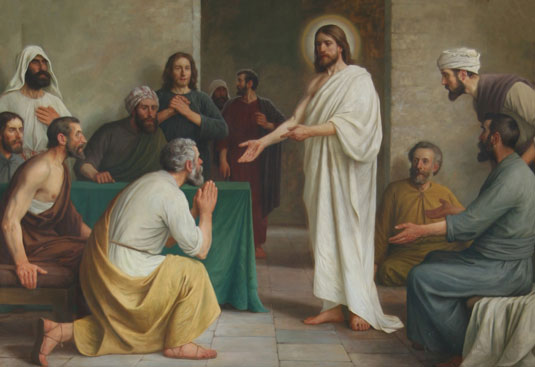
In John 20.19-23, Jesus appears in the upper room on the eve of his resurrection, and he breathes on the disciples saying, “Receive the Holy Spirit.” This is the so-called Johannine Pentecost, and at a glance, it would seem to contradict the very clear teaching of the book of Acts that the Spirit was given on the Day of Pentecost some 50 days after Jesus’s resurrection. If the events of that first Pentecost are understood as the climactic coming of the Spirit to indwell the followers of Christ, then Jesus’ giving of the Spirit in John 20.22 would seem to indicate that John (who was present at Pentecost) was hopelessly confused about the timeline. In the space the follows, I would like to suggest that John is not confused; rather, I think that John 20 presents Jesus’ giving of the Spirit as the breath of the new creation in fulfillment of Ezekiel’s restoration promises and in turn, it grounds the church’s corporate authority to forgive in the life of the risen Christ.
Of course, scholars and pastors have tried to resolve this tension in a variety of ways throughout the history of the church, and here I will identify just four. First, some suggest that the giving of the Spirit in John 20 is a kind of proleptic gift, a partial filling, that was meant to steel the disciples until the climactic coming of the Spirit 50 days later. Others suggest that John has theologized the giving of the Spirit by temporally relocating the event to the resurrection and directly connecting it with the risen Christ in light of his own “realized eschatology”. Still others suggest that John 20 functions as a kind of apostolic commission for the disciples which establishes their role as authoritative leaders in the early church. Finally, and this is my view, but the giving of the Spirit in John 20 should be understood as the inauguration of the age of the New Covenant/New Creation. This is not in contradiction to the Book of Acts and its descriptions of the Day of Pentecost. Rather, John has compressed these events theologically by linking the resurrection of Jesus with the concept of new creation, the giving of the Spirit, and the inauguration of eschatological life. He does this by alluding to the creation account in Genesis 1-2 and the New Covenant/Resurrection account in Ezekiel 36-37.
In John 20, the scene opens “On the first day of the week” (20.1), and this temporal note is repeated in our passage in 20.19, “when it was evening on the first day of the week.” This is a clear allusion to the first day of creation in Genesis 1. In other words, with the resurrection of Jesus comes a new first day, a new creation. This allusion is further confirmed by the fact that the scene takes place in a garden (19.31), and Mary mistakes the risen Christ for the “gardener” (20. 15). This is most likely a typological allusion to Christ as the second Adam. More significantly, we are told that Jesus “breathed on them.” The Greek word here (ἐνεφύσησεν ) is a verb that only occurs here in the New Testament. In the Greek translation of the Old Testament (LXX), in Genesis 2.7, we read that “The the Lord God formed the man out of the dust from the ground and breathed the breath of life into his nostrils, and the man became a living being.” In the same way (and with same word) that God breathed life into Adam, so also the risen Christ breathes life into his disciples. This is not just incidental language; the Evangelist has utilized this rare word intentionally, because he wants to connect the resurrection of Jesus with the new creation. When Jesus breathes the Holy Spirit on the disciples, they become participants in a new humanity.
However, there is another important Old Testament allusion that stands in the background of John 20, and that is the description of the New Covenant and the story of the Dry Bones in Ezekiel 36-37. In Ezekiel 36.26-27 (also 37.14), we read,
I will give you a new heart and put a new spirit within you; I will remove your heart of stone and give you a heart of flesh. I will place my Spirit within you and cause you to follow my statutes and carefully observe my ordinances.
And in Ezekiel 37.1-14, we read where Ezekiel is commanded to prophesy to the breath to “come from the four winds and breath (ἐμφύσησον) into these slain so that they may live.” In the same way that Ezekiel stood in the midst of the valley of dry bones and the dead came to life by the “breath/Spirit” of God, so also the risen Christ stands in the midst of his disciples who are “dead/paralyzed” in fear, and breathes into them the Spirit of life. Now, in the book of Ezekiel, these chapters drip with corporate overtones, particularly in regard to the restoration of the people of Israel. The dry bones coming to life is a symbol of national (and individual) resurrection and restoration, and the Johannine Pentecost symbolizes the eschatological restoration of the people of God, such that the 12 (or 11) disciples function as the nucleus of that people as a renewed Israel. The point is that John portrays the resurrection of Jesus as the moment when the promised Spirit of restoration becomes reality.
Now, it is important here that we stop and recall what John has already said back in John 7. 39, where we read, “Those who believed in Jesus were going to receive the Spirit, for the Spirit had not yet been given because Jesus had not yet been glorified.” This is the heart of John’s theology, namely that the glorification/exaltation of Christ comes in the crucifixion/resurrection of Jesus. We know this because, Jesus said in John 12:32, “As for me, if I am lifted up from the earth I will draw all people to myself.” He said this to indicate what kind of death he was about to die.” The verbal idea of being “lifted up” refers both to the kind of death he would die but also to the idea of exaltation. Point being that in John 20, Jesus has now been glorified and so the Spirit can now be given as a sign of eschatological life.
However, there is one more problem in this passage. In verse 23, we read where Jesus tells the disciples, “If you forgive the sins of any, they are forgiven them; if you retain the sins of any, they are retained.” Of course, this language also occurs in the Gospel of Matthew, in Matthew 16:19 in Jesus words to Peter and then again in 18:18 in the context of the Community Discourse. Clearly, this is the language of commissioning and authority, but exactly what kind of authority is in view here is debated. Some (particularly in the Roman Catholic and Eastern Orthodox traditions) understand these words to signify Apostolic/priestly authority to absolve sins. Others understand them to describe the authority of the church to announce the promise of forgiveness on the basis of the gospel. In my view, in the context of John 20, these words demonstrate that the Spirit-empowered community participates in the eschatological sorting of humanity. Forgiveness is determined by a person’s acceptance or rejection of the person and work of the Son (cf. John 3:18-21), but the church’s authority to forgive is part of its new-creation governance. In other words, just as the first humans were given dominion in the Garden of Eden (Genesis 1:28), so also the church as a new humanity is given Spirit-authorized responsibility as an agent of new-creation reconciliation. And John is clear that this authority is derivative, not autonomous; it flows from the risen Christ’s life and breath (i.e. Spirit).
In conclusion, then we must conclude that the Johannine Pentecost is not simply the relocation of the events of Acts 2; these are distinct narrative events serving distinct theological purposes. Whereas Acts emphasizes the public outpouring of the Spirit, the gift of tongues, and the church’s mission to the nations, John emphasizes the new creation, the restoration of the people of God, and ecclesial authority and identity. To put it more simply, John narrates the ontological beginning of the New Covenant age, and Luke narrates the Spirit-empowered expansion of the church’s mission. There is no contradiction; these are simply two theological angles on one redemptive reality. By tying his narrative to Genesis and Ezekiel, John gives us a theologically robust understanding of the significance of Christ’s resurrection. More importantly though, John 20.19-23 clearly demonstrates that the church exists because the risen Christ breathes his life into it. Its life is cruciform and Spirit-dependent, and its mission is one of reconciliation in the power of the new creation.

 Faith seeking Understanding