Category Archives: Worship & Liturgy

On the Lack of Deep Biblical Preaching in the Church Today

teaching_preaching_church_teachers

When I was in seminary, it was pretty commonplace to hear my fellow classmates lamenting the lack of deep biblical preaching in churches today. These were pastors, teachers, and missionaries in training, and, certainly, their passion for the preaching office in the church is to be lauded. However, I think that in our zeal for deep preaching, it would be easy to develop an overly critical attitude when listening to sermons being preached. Nevertheless, as listeners, we must be discerning of what we hear. The difficulty is that the very concept of deep preaching is somewhat nebulous. What makes a particular sermon deep? What are the defining characteristics of a deep sermon? It is probably easier to define what deep preaching is not as opposed to what it is, so in that regard, what follows are some guidelines for identifying what deep preaching is not.

Deep preaching is not a seminary lecture. Preaching is not the time for an information dump of all that a preacher knows about a given passage. A seminary lecture has as its primary purpose to educate and to inform, and it is set in a classroom setting that is focused primarily on learning. Now, while these purposes certainly overlap with that of a sermon, they are still two quite distinct entities. A sermon must be catered to the audience and context for which it is intended, and it must be more than the dissemination of information.

Deep preaching is not a lesson in Greek or Hebrew. Studying the original languages of Holy Scripture is certainly a valuable, and I think it is a necessary resource for sharpening a pastor’s understanding of a given passage. But the pulpit is not the place to be giving vocabulary lessons. Use the original languages to inform your study, but then translate that meaning into the sermon in a way that people who have never been exposed to the original languages can understand. And don’t try to pronounce or include words from the original language in order to impress people with how much you know.

Deep preaching is not locked in the past. Here again, historical analysis and socio-cultural insights are important and helpful for understanding a given passage, and as those details serve to make the meaning of the text clearer, they can and should be included in the sermon to help listeners understand the text. However, a sermon that remains in the past and never brings the meaning forward to the present is not deep. It is merely a history lesson.

Deep preaching is not unnecessarily complex. All of the above leads us to this, that deep preaching is not complex for the sake of being complex. Literary, linguistic, historical, and cultural details all must serve the ultimate purpose of making the meaning of the text clear. Certainly some passages and genres are more demanding than others making the various contextual details necessary, but, ultimately, everything that is said and done in a sermon must relate to overall meaning of the text and serve to make it clear.

Deep preaching is not interested in self help, nor does it seek to entertain. This is perhaps what my seminary peers were concerned with in their laments, but ultimately the purpose of a sermon is not to give helpful advice for life, to make people laugh or feel good about themselves or their lives. The purpose of a sermon is to present listeners with the risen Lord Jesus Christ, to point them to the Gospel and their need for a savior, and to be the avenue the Spirit uses to call people to repentance and faith.

Now, let me be clear, I love studying the literary/grammatical and historical sociocultural contexts of the Bible, but expository preaching must not content itself with what the Biblical authors once said. No, it must move forward to what the Spirit is saying. So, in that light, let us move on to what deep preaching is.

Deep preaching is focused on the text. Let the main thing be the main thing, and the main thing in preaching is the text of Holy Scripture. It is the text that is inspired by the Holy Spirit, it is the text that the Spirit uses to touch hearts and change lives, and it the text that ultimately holds up Jesus as the author and finisher of our faith. In the sermon, pastors should not be giving their opinions or addressing their favorite soapboxes or hobbyhorses or whatever may be the hot topic from the news cycle that week. As Paul told the young pastor Timothy, “Preach the Word!” (2 Tim. 4:2)

Deep preaching is geared toward life change. The Bible refers to it as edification, but all that really means is that preaching is for the purpose of making more faithful disciples of Jesus Christ. That should be the goal in all we do from pulpit to piano to parking lot, to equip people for living this thing called the Christian life. Ultimately, we know that true life change is brought about by the Spirit, and the Word is His sword. Preachers are the handles of that sword as they faithfully proclaim the Spirit inspired message of Holy Scripture week in and week out, so that the Spirit can do His work of transforming sinful human beings into the image of Jesus Christ.

Deep preaching comes from a place of personal conviction. If a pastor has not been personally touched, convicted, comforted, challenged, or changed by a particular passage or sermon, then he should not be preaching it. This means that in addition to historical and literary study of the text, the preacher should be spending time in those classic word centered spiritual disciplines, i.e. meditation, prayer, and fasting, so that the truth of the Scripture is burned into his very soul. Preaching from a place of Spirit led conviction yields spiritual power, authenticity, and real life to the sermon being preached. If you want your listeners to be changed by the sermon you are preaching, then you had better be changed by it too.

See also Edwards, J. Kent. Deep Preaching: Creating Sermons that Go Beyond the Superficial. Nashville, Tenn.: B&H Academic, 2009.

On the Use and Benefit of the Lectionary

lectionary

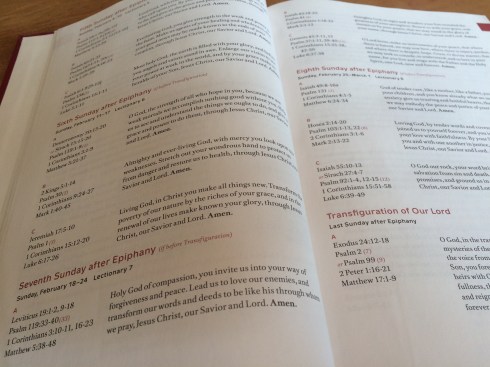
I have recently begun using the lectionary as the basis for my Sunday morning sermons. Now, this is a practice that is quite alien to most of the non-liturgical free church origin churches here in the “Bible Belt”. However, I can report that the reception of this practice has been quite positive.

For those who do not know, a lectionary is simply a weekly schedule of scripture readings that takes us through the entire text of the Bible once every three years, and the way it does this is by assigning four scripture readings per week that are then read aloud during weekly community worship gatherings. These four passages always include an Old Testament passage, a Psalm, and New Testament passage from Acts through Revelation, and a Gospel passage.

The following are some reasons I find this practice beneficial and useful::

  1. The Public Reading of Scripture – Paul gives clear instruction to Timothy for his ministry in Ephesus, saying, “Until I come, give attention to the public reading of scripture, to exhortation, to teaching.” (1 Timothy 4:13 NET) The corresponding note on that verse gives the following explanation:

    tn Grk “reading” sn The public reading of scripture refers to reading the scripture out loud in the church services. In a context where many were illiterate and few could afford private copies of scripture, such public reading was especially important.

    Even though the modern context is no longer challenged by the problem of illiteracy and practically everyone has their own private copy of the Holy Scriptures, Paul’s instruction is nevertheless pressing for churches today. More often than not, the only scripture that is read out loud during a worship service is that which pertains to the pastor’s sermon. So, in total, congregants are exposed to only a handful of verses, a minimal amount of God’s word, week after week. However, by following a lectionary, the congregation is exposed to larger chunks of Holy Scripture from a variety of books, authors, and genres. When these larger pericopes are read out loud every week after week during community worship, it guarantees that the church’s corporate life together is being shaped and molded by the Scriptures themselves.

  2. Biblical Literacy and the Metanarrative of Scripture – Now, as I stated, our modern culture is no longer challenged by the problem of illiteracy, but our churches are filled with people who are biblically illiterate, people who are mostly unfamiliar with the warp and woof of the Bible’s story, who cannot identify the important people and major events in salvation history, who do not understand the Bible’s major themes, big ideas, and central emphases. When we read out loud every week from an Old Testament passage, a Psalm, a New Testament passage from Acts-Revelation, and a Gospel, we are helping our congregations get a grasp of the metanarrative of Scripture, to see how the parts relate to the whole, to see how God’s plan for the salvation of His people runs through every book of the Bible.
  3. Relation to the Church Calendar – The lectionary schedule of readings typically follows the seasons of the church calendar, i.e. Advent, Christmas, Epiphany, Lent, Easter, Pentecost, Ordinary Time, and by doing so, it focuses our reflections on the life and ministry of our Lord Jesus Christ. So, instead of having to find a text to match a particular civil, cultural, or sentimental holiday, the texts of the lectionary center on the movements of the Gospel as we walk through the seasons of the church year. Every Sunday, the corresponding texts from the lectionary drive us back into the Gospel story, and by doing this, they form our identity and self understanding, they form our community worship life together, and they form our sense of purpose and mission.
  4. Freedom from the Burden of Selecting Texts/Topics – Perhaps one of the most challenging burdens for pastors/teachers is the weekly question of what to teach for the upcoming week. Often, in spite of an already full schedule of meetings, appointments, planning, and programs, leaders have to try to carve out time for study, meditation, and writing, usually, 2-3 lessons per week. Now, of course, we certainly want to rely upon the guidance of the Spirit in this process, because it is His words that congregants need to hear. He is the one who convicts sin, calls people to salvation, changes hearts, etc. However, more often than not, pastors/teachers tend to gravitate toward passages they have already studied and/or preached, toward their preferred hobbyhorses or soapboxes, or toward passages that are fairly easy and straightforward. The lectionary can help pastors plan out their preaching schedules, and it can challenge them to preach on texts and/or topics that they otherwise wouldn’t necessarily address.

Of course, pastors have the freedom to preach from all the lectionary texts, just a few, or even just one. They also have the freedom to depart from the lectionary for purposes of sermons and lessons, if so led by the Spirit; still, the lectionary passages could be read out loud as a part of the larger worship experience. In the final analysis, we want to let the main thing be the main thing, and for Christians the main thing is the inspired Word of God. May it be central to all that we are and all that we do.


Slow To Write

"let every person be quick to hear, slow to speak, slow to anger."

lovegavehope

Just another WordPress.com site

Jared Cornutt

Pastor | Speaker | Writer

Denny Burk

A commentary on theology, politics, and culture

G3 Ministries

Events + Resources for the Local Church

Biblical Reasoning

Biblical and Systematic Theology According to the Scriptures

RetroChristianity

Reclaiming the Forgotten Faith

SBC Voices

Southern Baptist News & Opinion

Lucid Theology

Thoughts on words, books, theology, and life.

Baptist21

A pastor-led voice for Baptists in the 21st century

Center For Baptist Renewal

The Personal and Professional Blog of Phillip Powers

The Pastor's Well - Pastor Well

The Personal and Professional Blog of Phillip Powers

Articles - AlbertMohler.com

The Personal and Professional Blog of Phillip Powers

The Gospel Coalition

The Personal and Professional Blog of Phillip Powers