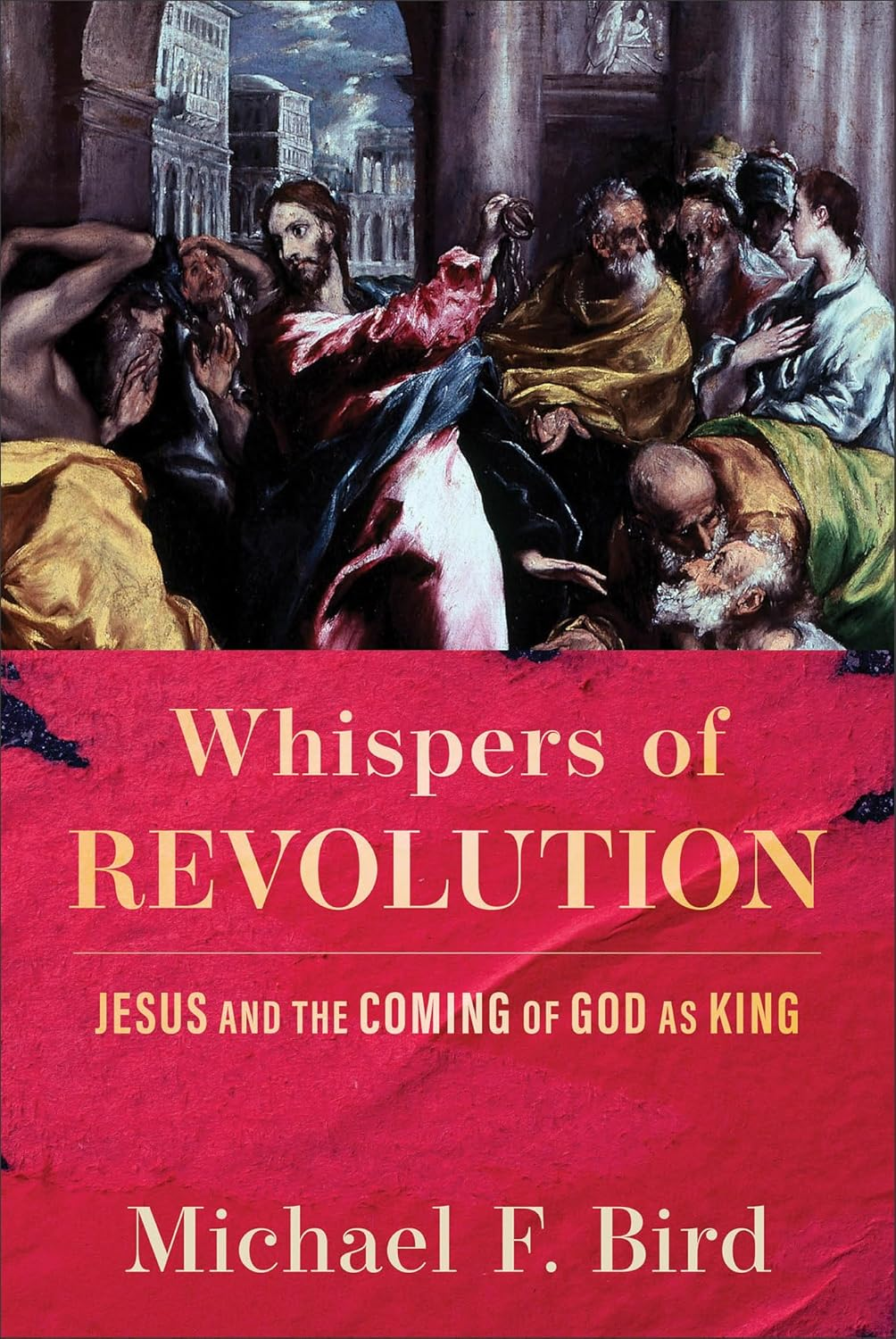
Bird, Michael F. Bird. Whispers of Revolution: Jesus and the Coming of God as King. Grand Rapids: Baker Academic, 2025.
When we confess that Christ is King, we are tapping into a longing that goes back to the very beginning of creation. Adam and Eve were placed in the garden of Eden to serve as God’s vice-regents, to rule and to establish his dominion in the world. Of course, our first parents failed when they succumbed to the deceptions of the serpent, and from that point on, the story of the Bible revolves around God’s plan to reestablish his dominion in the world. In a new book entitled Whispers of Revolution: Jesus and the Coming of God as King, Michael F. Bird applies this lens to the person and work of Jesus of Nazareth. Bird is Deputy Principle and Lecturer in Theology at Ridley College, Melbourne, and he is the author of over 30 books, including the award winning The Gospel of Lord: How the Early Church Wrote the Story of Jesus. In this book, Bird argues that Jesus was driven by the conviction that through his words and work, through his mission and message, God was unveiling his kingship in a way that would rescue Israel and eventually restore the whole world.
Bird’s essential thesis is that the life and ministry of Jesus is best understood within the context of Jewish restoration eschatology. Jewish restoration eschatology is simply the hope that one day God would bring an end to Israel’s exile, restore their national and spiritual life as his people, and through them bring the nations into submission under his rule. This hope is grounded in the visions of the canonical prophets, and it serves as the foundation for the theology and worldview of Second Temple Judaism. For Bird, this worldview “provides the key to understanding Jesus’ mission, aims, self-understanding and hope.” (56) With this lens in view, then, Bird goes on to walk through the Gospel accounts to show how the details of the Jesus earthly ministry fit within this framework. Along the way he discusses topics such as, the birth and early life of Jesus, Jesus’ self-understanding of himself as Messiah, his teaching about the Kingdom of God and other topics, his interactions with his contemporaries, his’ last days in Jerusalem, and his death and resurrection. In all of this, God is coming, coming as king. He concludes, “Jesus himself started the whisper of this revolution, one involving a reordering of power, Israel’s regathering, the redemption of the Jews, the defeat of Satan, and the renewal of creation.” (300) However, this good news could not remain a whisper; it had to be shared, repeated, declared, argued, and even shouted afar. And this is exactly what Jesus instructed his followers to do.
In terms of strengths, Bird is particularly helpful when he is discussing the place of historical Jesus studies in relation to New Testament Theology. After all, Jesus did not write any of the books that we have included in the NT canon. Technically, the NT Documents are written about him, but none of them were actually written by him. So, we may rightly speak of the theology of Matthew or Luke or Mark or John, but can we also speak of the theology of Jesus himself? Bird suggests that the study of the historical Jesus is a necessary prolegomena o our study of NT theology. Jesus is the church’s primal theologian, and it is his teaching, his ministry, his life and death that stands at the heart of the New Testament. Therefore, we cannot simply relegate historical Jesus studies to the domain of historians alone; no, the study of historical Jesus is a fundamental component of the theologians toolbox when it comes to understanding the theology of Paul or John or Matthew or Peter or James. Bird writes, “Jesus was the first theologian of the Jesus movement, and his is the creative mind behind so much of the church’s generative tradition.” (15-16) This means that the theology of the NT should find its impetus, not exclusively but at least initially, on the lips of Jesus of Nazareth. He goes on to write that, “the study of the historical Jesus is a reminder that the ‘word became flesh’.” (17). In other words, if we truly believe that our faith in grounded in the historical realities of Jesus life and ministry, death and resurrection, then we must give the study of the historical Jesus its proper place when it comes to understanding the New Testament.
One minor reservation that I have concerns Bird’s relatively frequent appeal to the Gospel of Thomas. Thomas is a mid-to-late second-century sayings collection comprising 114 logia attributed to Jesus, many of which exhibit clear literary and thematic dependence upon Synoptic tradition. While some scholars continue to argue that Thomas may preserve independent and possibly early Jesus traditions, the case for its independence remains highly contested. In numerous instances, the parallels suggest secondary development rather than primitive preservation, and several logia reflect theological trajectories consistent with the emerging Gnostic or proto-Gnostic tendencies. To be clear, Thomas is an important witness to the reception and reinterpretation of Jesus’ sayings in the second century. However, its value for reconstructing the historical Jesus is, in my view, extremely limited. For that reason, Bird’s approximately twenty-two references to Thomas—nearly half the number of his citations of the far more substantial and canonically received Gospel of John—feel somewhat disproportionate. While these references do not materially affect his overall thesis, a more restrained use of Thomas would have strengthened the historiographical clarity of the argument.
Whispers of Revolution is not a fifth gospel but at the same time it is not merely a gospel harmony. It is historically grounded, insightful, and clarifying reconstruction of Jesus within the context of first century Judaism and its hopes for restoration. And insofar as the historical study of Jesus of Nazareth is “indispensable for religious scholarship and the life of Christian faith” (14), Bird’s book is both accessible and academically rigorous. It will be a great benefit both to lay Christians who want to understand Jesus and the gospels better and to scholars who are looking for a clear and coherent understanding of Jesus to which they can correlate their own work. And so, I would gladly recommend this book, and if I were ever to teach a course on the life of Jesus or the Gospels, I would require it for my students. When Jesus was with his disciples at Caesarea Philippi, he asked them, “Who do people say that I am?”, and then, more importantly, he asked them, “Who do you say that I am?” This is the fundamental question we must all be able to answer. Bird has answered it: Jesus was a messianic prophet of Jewish restoration in fulfillment Old Testament hopes. While Jesus was certainly more than this, he was certainly not less, and Whispers of Revolution is a great book for those who want to understand the life and times, the ministry and message of Jesus as he himself might have understood it.


 Faith seeking Understanding
March 9th, 2026 at 8:02 AM
[…] my last post, I argued that the apocryphal Gospel of Thomas has little to no value when it comes to the study of […]