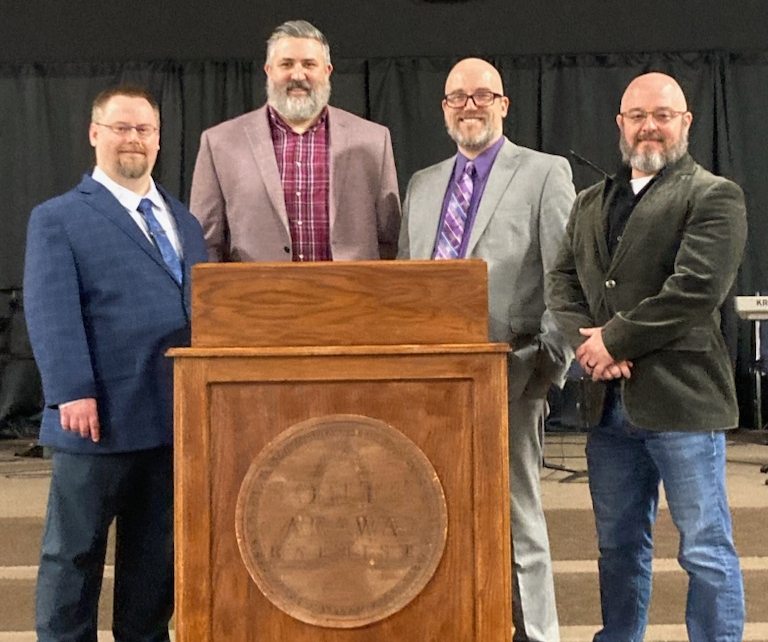
Tag Archives: Plurality of Elders

On a Vision for Cooperative Preaching Ministry

A well known seminary president recently tweeted, “Any consideration of Christian preaching must begin with the realization that preaching is essentially an act of worship—the central act of Christian worship.” Putting the possible overstatement aside, the preached word has been a staple of the church’s theological, doxological, and ethical life together since its very inception. Even today, in most churches, preaching occupies the primary place of emphasis and importance in the weekly worship gathering. However, more often than not, the priority of preaching in today’s churches has to do with the charisma and polish of the preacher rather than the authority of God’s Word. We have created a celebrity culture that platforms the personality of the most proficient speakers among us, so that the local church’s experience of the word of God revolves around the insight and understanding of one man.

However, if we believe that a plurality model is the most biblically consistent model for pastoral leadership in the church, then it necessarily follows that we should apply that model to the ministry of preaching as well. In other words, if the responsibilities and burdens of pastoral ministry are best shared among a band of brothers who are equal in position and authority, then the responsibility and burden of the word of God should be shared also. In the paragraphs that follow, I would like to highlight three ways in which a cooperative approach to preaching can benefit the local church, and then I would like to sketch briefly what this approach might look like practically.

The first way that this approach benefits the local church is that it nourishes the primary preaching pastor(s) by helping him to keep his spiritual tank full and avoid burnout. Week after week, the teaching pastor is responsible for feeding the flock; he is locked away in his study preparing lessons and bible studies and sermons. He is expected to give and give and give of himself, and when this continues without any respite, eventually his spiritual fuel tank will hit zero. Of course, most teaching pastors are glad to do this, but the question remains: who feeds the pastors? Shouldn’t the teaching pastor also be able to find spiritual nourishment within the local body of Christ as God intended, or must he resort to online preaching from pastors he admires but doesn’t know personally? A cooperative approach to teaching in the local church helps us to care for and sustain every part of our body, especially the pastors and teachers who faithfully sustain us. 

A second way this approach benefits the local church is that it provides the flock with a diversified diet of spiritual truth. Of course, God’s truth is absolute and unchanging, but it comes to us in vessels that are finite, broken, incomplete. No one has an exhaustive and complete understanding of everything in the Bible. No matter how much they might prepare and study, on this side of glory, their understanding of its truths will always be incomplete. Moreover, every minister of God’s Word comes to the text with different backgrounds, different experiences, different perspectives, and this is a good thing, because, as the Scriptures remind us, “iron sharpens iron” (Proverbs 27.17). There is nothing wrong with one pastor or elder holding the primary teaching responsibility, but it is good and healthy for the congregation to hear from other faithful voices from time to time. In this way, the congregation cultivates a complementary and more holistic understanding of the truth.

And lastly, the third way that a cooperative approach to pulpit ministry benefits the local church is that it accomplishes our commission. The Great Commission is to make disciples, and part of making disciples, as the Apostle Paul instructed Timothy in Second Timothy, chapter 2, verse 2, is committing to faithful men what we have heard who will then be able to teach others also. Local churches are called to train up the next generation of leaders, faithful men who can step into the pulpit and teach the Word of God faithfully. As pastors and elders, we must look forward to our succession. Who have we invested in that will be able to take up the baton of God’s Word when we are gone? A collaborative approach to teaching allows us to train and prepare faithful men, to give them the opportunity to stand before their spiritual family and teach the Word of God in the safety of a community that loves and supports them. 

In an ideal plurality situation, the primary preaching pastor should preach between 35 and 40 sermons annually; mathematically, this would come out to about three sermons per month. The remaining 15 or so can be equally shared among the other members of the elder team. However, a cooperative approach to the ministry of preaching goes beyond the allocation of Sundays. It should include discussion and planning of the direction for not only the series overall but of individual texts, and it should also include the opportunity for evaluation and feedback. Of course, this approach does not remove the individual pastor’s responsibility for textual work; every minister of the word must commit themselves to hard work of plumbing its depths. But it does mean that we are not alone in the process. As plurality of brothers, we come alongside each other in the ministry of the Word, so that we all can attain unto “maturity with a stature measured by Christ’s fullness.” (Ephesians 4.13)

This article is also posted at SBCvoices, here.


On Unrealistic Expectations in Pastoral Ministry

It is no secret that the last few years have been extremely difficult for churches and even more so for pastors. Of course, pastoral ministry is commonly fraught with its own set of unique stresses, but those stresses have grown exponentially over the past few years due to the chaos and turmoil that has so regularly characterized our society. This has led to unprecedented numbers of pastors leaving the ministry, a trend some are now calling the “Great Resignation”. The Barna Group has recently reported that some 42% of pastors have given real, serious consideration to quitting being in full-time ministry within the last year, a number which is up 13 points from 29% just over a year ago. It is a trend that should concern all of us, both pastors and congregants alike. If pastors are called by God and love His church, why are they leaving ministerial service seemingly in droves?

Over at churchanswers.com, Thom Rainer recently shared some of his findings pertaining to this question in an article entitled “Ten Reasons Pastors Are Glad They Quit Vocational Ministry.” It would be redundant to reproduce the entire list here; however, suffice it to say that all of the reasons stated reflect the relief of having a massive burden lifted off of the shoulders. But what exactly is the massive burden that these former pastors were carrying? I believe that it was the unhealthy and unrealistic expectations of the church and its members. So many churches in this country expect their pastors to be superheroes, masters of every skill, having impeccable personality and charisma, able to carry every burden of ministry, always available, never to feel exhausted or drained or burned out. A quick perusal of online advertisements for pastoral openings reveals that for most churches, Jesus Christ himself wouldn’t be qualified; after all, he was a single thirty-something with no children, no experience, and no seminary training.

Whether because of the rise of celebrity pastor culture or due to the influence of values taken from the business/political world, expectations regarding pastoral responsibilities and qualifications in most churches are nearly unattainable. However, the problem is not necessarily that the expectations are wrong; they are usually reflections of a congregation’s felt needs or past hurts, though many of these still go unacknowledged or unspoken. Rather, the problem is that they are all heaped upon one person, i.e. the solo or senior pastor. This is why a plurality of elders leadership model is more healthy, because it shares the responsibilities of leadership among a group of biblically qualified and trained men. A single or solo pastor/elder is unable to be all things to all people at all times; he is not able to be everywhere and everything that the members of the congregation might need him to be. Or to put it another way, he is not omnipotent, omniscient, or omnipresent. He has limitations on his time, his energy, and his resources. A plurality model for elders eliminates these limitations by sharing the burdens of ministry among a group of pastors of equal authority and responsibility.

Of course, this does not mean that there are no qualifications or expectations for those called to serve as pastors. The Bible is clear that a man must be spiritually mature, that he must have proven Christ-like character as well as sound theological and biblical convictions. It is also clear that a pastor’s primary duty is to be devoted to prayer and to the ministry of the Word, to care for and feed the flock of God. In many ways, pastors should be held to a higher standard of faith and practice than the regular church member, but as church members, we must remember that our pastors are still human, that they are members of the same body, that they need the same care, encouragement, prayer, and support that we all need. This is why the Bible so often uses the body metaphor to symbolize the nature of the local church. As a body, the church has one head, and that head is Jesus Christ. Beyond that, the rest of the parts of the body are interdependent, and pastors are just one of the parts of that body. They need the life and nourishment of the body just as much as any other part. As the Apostle Paul puts it,

Now as we have many parts in one body, and all the parts do not have the same function, in the same way we who are many are one body in Christ and individually members of one another.

~Romans 12.4-5

Like any relationship, the relationship between pastors and church members must be grounded in trust, worked out through open and honest communication, and always characterized by grace toward one another, because only when both sides are able to admit their most vulnerable needs without fear of judgment will we be able to build the kind of foundation that can sustain long-term ministry faithfulness. It is the church’s Scriptural responsibility to raise up men from within their body to serve as pastors/elders. However, so many churches in the world today have adopted the mindset that they exist only to be served by their pastors, rather than to serve them. This attitude is the primary reason that good and godly men flee pastoral ministry in droves. They have been used up and beat down over and over; they have been chewed up and spit out too many times. We desperately need to rediscover what it means to build each other up rather than tear each other down, and this applies to pastors as much as it does everyone else. Who is caring for the pastors? Because they desperately need it.

This article is also posted at SBCVoices, here.


Slow To Write

"let every person be quick to hear, slow to speak, slow to anger."

lovegavehope

Just another WordPress.com site

Jared Cornutt

Pastor | Speaker | Writer

Denny Burk

A commentary on theology, politics, and culture

G3 Ministries

Events + Resources for the Local Church

Biblical Reasoning

Biblical and Systematic Theology According to the Scriptures

RetroChristianity

Reclaiming the Forgotten Faith

SBC Voices

Southern Baptist News & Opinion

Lucid Theology

Thoughts on words, books, theology, and life.

Baptist21

A pastor-led voice for Baptists in the 21st century

Center For Baptist Renewal

The Personal and Professional Blog of Phillip Powers

The Pastor's Well - Pastor Well

The Personal and Professional Blog of Phillip Powers

Articles - AlbertMohler.com

The Personal and Professional Blog of Phillip Powers

The Gospel Coalition

The Personal and Professional Blog of Phillip Powers