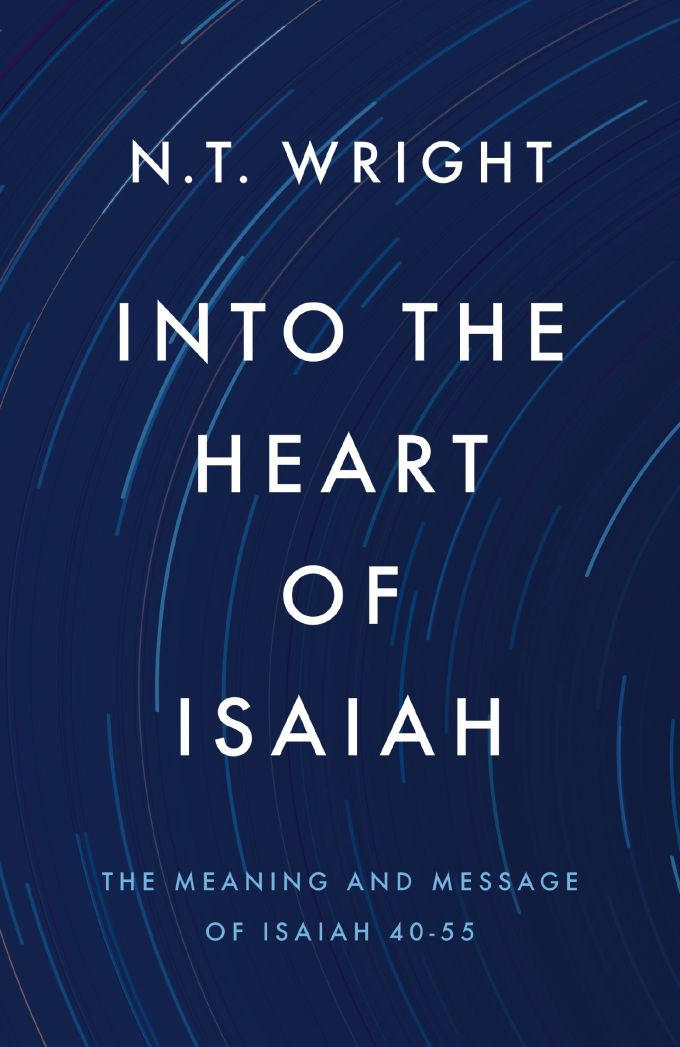
Wright, N.T. Into the Heart of Isaiah: The Meaning and Message of Isaiah 40-55. Zondervan, 2026.
When it comes to the Old Testament, few books exert more influence over the New Testament authors than the Book of Isaiah. Isaiah’s vision of Israel’s restoration and his understanding of the mission of the messianic servant significantly shape how the New Testament authors present the person and work of Jesus. So, a robust understanding of Isaiah is absolutely crucial for understanding the New Testament. This is perhaps why N. T. Wright, a New Testament scholar by trade, has written a book on the essential message of Isaiah. In Into the Heart of Isaiah: The Meaning and Message of Isaiah 40–55, Wright takes up the central and pivotal chapters of Isaiah in order that we might rightly understand the beauty of their message. In particular, Wright seeks to hear these chapters at several different levels: as a message addressed to Isaiah’s original audience, as a theological vision that finds its fulfillment in Jesus, and as Scripture that continues to speak to the church today. The particular strength of Wright’s approach is his determination to allow Isaiah 40–55 to be heard at each of these focal distances without allowing any one of them to eclipse the others. The result is an accessible and often devotional reading of Isaiah that nevertheless takes seriously the historical and theological horizons of the text.
One of the more helpful features of Wright’s approach is what he describes as a “varifocal” reading of Isaiah 40–55. At the first level, Wright wants us to hear Isaiah’s message within its own historical setting and to consider how its promises would have been understood by those who first received them. This means resisting the temptation to move too quickly from Isaiah to Jesus without first reckoning with the historical realities of exile, restoration, Jerusalem, and the return of YHWH that give these chapters their original shape. Yet Wright does not believe that recovering this historical horizon exhausts the meaning of the text. At a second focal distance, he asks how the theological expectations developed throughout Isaiah 40–55 find their fulfillment in Jesus and shape the New Testament’s presentation of his person and work. Finally, Wright brings the text into the present and asks how Isaiah continues to address the church and the Christian life today. What I particularly appreciate about this approach is that Wright does not require the reader to choose between hearing Isaiah historically and reading Isaiah as Christian Scripture. Historical exegesis, christological fulfillment, and contemporary application are not treated as competing interpretations but as different focal distances from which the same scriptural text can be heard. This varifocal approach consequently allows Wright to take Isaiah’s original message seriously while still asking the distinctly Christian question of how that message reaches its fullest significance in Jesus.
Central to Wright’s reading is his insistence that Isaiah 40–55 should be heard as a unified poetic movement rather than merely as a collection of individual prophetic passages. The message that begins with the announcement to “Comfort, comfort my people” in Isaiah 40 develops across these chapters as a sustained proclamation of Israel’s restoration. Wright organizes this movement particularly around two closely related themes: the return of YHWH to Zion and the work of the Servant. Israel’s exile has raised the question of whether YHWH has abandoned his people and whether the promises associated with Jerusalem can still be trusted. Isaiah’s answer is the announcement that Israel’s God is returning to restore Zion and establish his reign. Yet intertwined with this expectation is the increasingly prominent figure of the Servant, whose vocation becomes essential to the accomplishment of God’s restorative purposes. These themes should therefore not be isolated from one another or treated as disconnected elements within the larger collection. Rather, Wright encourages the reader to follow their development across Isaiah 40–55 and to hear the individual passages as parts of a larger poetic and theological movement. This emphasis on reading the chapters together is one of the book’s important strengths, since it allows familiar passages concerning the Servant, restoration, and the return of YHWH to be heard within the larger theological vision in which Isaiah has placed them.
These two themes—the return of YHWH and the work of the Servant—provide Wright with the theological framework for following Isaiah’s argument through the remainder of these chapters. The announcement of YHWH’s return in Isaiah 40 is not simply a promise that Israel’s exile will end; it is the declaration that Israel’s God is coming again to Zion to reign, restore his people, and accomplish the purposes for which he called them. At the same time, the Servant emerges within this movement as the figure through whom those restorative purposes are advanced. The Servant’s vocation is bound up not only with Israel’s own restoration but also with the extension of God’s saving purposes to the nations. Wright therefore reads the familiar Servant passages not as isolated predictions inserted into an otherwise unrelated collection, but as integral moments within Isaiah’s larger story of YHWH’s return and Israel’s restoration. This becomes especially significant as the movement approaches Isaiah 52–53, where the suffering and vindication of the Servant stand near the theological center of the restoration Isaiah has been announcing. For Wright, these themes ultimately provide an important bridge to Jesus: the New Testament’s claims about Jesus as the suffering Servant and the return of Israel’s God are deeply rooted in the theological world created by Isaiah 40–55. The strength of Wright’s reading is therefore not simply that he identifies these themes, but that he encourages us to hear how they develop together across the poem.
It is important to recognize, however, that Into the Heart of Isaiah is not primarily an academic monograph or technical commentary on Isaiah 40–55. Wright is clearly aware of the scholarly conversations surrounding these chapters and regularly demonstrates familiarity with the interpretive questions they raise, but his primary concern is not to adjudicate every academic debate. Rather, he wants his readers to hear the theological and spiritual force of Isaiah’s message. In this respect, the devotional character of the book is not a weakness but an important part of its purpose. This theological and devotional orientation allows Wright to translate the fruits of serious engagement with Isaiah into an exposition intended not merely to inform the reader but to form the reader’s understanding of God, Christ, and the Christian vocation.The result is a book that should be accessible to pastors, students, and thoughtful Christian readers without requiring extensive familiarity with the technical literature on Isaiah. Readers looking for sustained engagement with the critical debates surrounding Isaiah 40–55 will naturally need to look elsewhere. Nevertheless, Wright succeeds in occupying a helpful space between academic exegesis and Christian devotion, drawing upon the insights of the former in order to serve the latter.
If there is one area where I would have liked Wright to go further, it is in situating Isaiah 40–55 more fully within the literary and theological movement of the Book of Isaiah as a whole. Wright makes a compelling case for hearing these chapters as a unified poetic movement, and his attention to the return of YHWH, the restoration of Israel, and the vocation of the Servant helps the reader appreciate how the various parts contribute to that larger message. Yet these themes do not begin with Isaiah 40, nor do they reach their conclusion with Isaiah 55. The expectation of restoration emerges from the covenantal crisis and judgment developed throughout Isaiah 1–39, while themes such as the restoration of Zion, the inclusion of the nations, and the renewal of creation continue to develop in Isaiah 56–66. Greater attention to these connections would, in my judgment, have strengthened Wright’s reading by showing how the unified movement he identifies in chapters 40–55 participates in the still larger theological movement of Isaiah 1–66. To be fair, such a treatment would extend beyond the stated purpose of the book, and Wright cannot reasonably be expected to provide a theology of the entire Book of Isaiah in a volume devoted specifically to chapters 40–55. Nevertheless, readers would benefit from seeing more clearly how the “heart of Isaiah” remains connected to the body of the book around it.
Overall, Into the Heart of Isaiah provides an accessible and theologically rich guide to one of the most important portions of the Old Testament. Wright is at his best when he encourages readers to hear Isaiah 40–55 as a sustained proclamation of the return of YHWH, the restoration of his people, and the vocation of the Servant through whom God’s purposes move forward. Yet perhaps the greatest strength of the book is the varifocal approach that governs Wright’s reading. He takes seriously the historical world in which Isaiah’s message was first heard without allowing that historical horizon to become the endpoint of interpretation. At the same time, he reads Isaiah unapologetically as Christian Scripture, tracing its theological trajectories into the person and work of Jesus and asking how its message continues to address the church today. Although I would have welcomed greater attention to the place of Isaiah 40–55 within the Book of Isaiah as a whole, this limitation does little to diminish the value of what Wright has accomplished. For pastors, students, and Christians seeking to understand why these chapters have been so important for Christian theology and the New Testament’s presentation of Jesus, Wright has provided a thoughtful and engaging guide. Into the Heart of Isaiah succeeds precisely because it invites us not simply to analyze Isaiah’s poetry, but to hear its message—and to hear it at each of the focal distances at which Christian readers must learn to listen.


