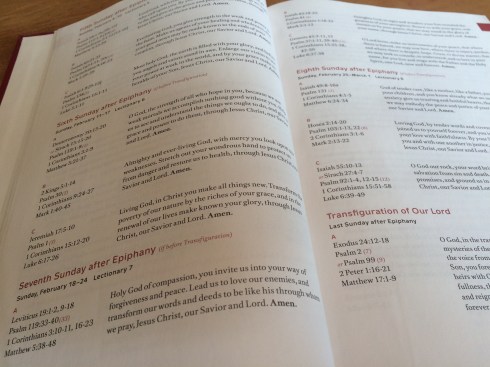
I have recently begun using the lectionary as the basis for my Sunday morning sermons. Now, this is a practice that is quite alien to most of the non-liturgical free church origin churches here in the “Bible Belt”. However, I can report that the reception of this practice has been quite positive.
For those who do not know, a lectionary is simply a weekly schedule of scripture readings that takes us through the entire text of the Bible once every three years, and the way it does this is by assigning four scripture readings per week that are then read aloud during weekly community worship gatherings. These four passages always include an Old Testament passage, a Psalm, and New Testament passage from Acts through Revelation, and a Gospel passage.
The following are some reasons I find this practice beneficial and useful::
- The Public Reading of Scripture – Paul gives clear instruction to Timothy for his ministry in Ephesus, saying, “Until I come, give attention to the public reading of scripture, to exhortation, to teaching.” (1 Timothy 4:13 NET) The corresponding note on that verse gives the following explanation:
tn Grk “reading” sn The public reading of scripture refers to reading the scripture out loud in the church services. In a context where many were illiterate and few could afford private copies of scripture, such public reading was especially important.
Even though the modern context is no longer challenged by the problem of illiteracy and practically everyone has their own private copy of the Holy Scriptures, Paul’s instruction is nevertheless pressing for churches today. More often than not, the only scripture that is read out loud during a worship service is that which pertains to the pastor’s sermon. So, in total, congregants are exposed to only a handful of verses, a minimal amount of God’s word, week after week. However, by following a lectionary, the congregation is exposed to larger chunks of Holy Scripture from a variety of books, authors, and genres. When these larger pericopes are read out loud every week after week during community worship, it guarantees that the church’s corporate life together is being shaped and molded by the Scriptures themselves.
- Biblical Literacy and the Metanarrative of Scripture – Now, as I stated, our modern culture is no longer challenged by the problem of illiteracy, but our churches are filled with people who are biblically illiterate, people who are mostly unfamiliar with the warp and woof of the Bible’s story, who cannot identify the important people and major events in salvation history, who do not understand the Bible’s major themes, big ideas, and central emphases. When we read out loud every week from an Old Testament passage, a Psalm, a New Testament passage from Acts-Revelation, and a Gospel, we are helping our congregations get a grasp of the metanarrative of Scripture, to see how the parts relate to the whole, to see how God’s plan for the salvation of His people runs through every book of the Bible.
- Relation to the Church Calendar – The lectionary schedule of readings typically follows the seasons of the church calendar, i.e. Advent, Christmas, Epiphany, Lent, Easter, Pentecost, Ordinary Time, and by doing so, it focuses our reflections on the life and ministry of our Lord Jesus Christ. So, instead of having to find a text to match a particular civil, cultural, or sentimental holiday, the texts of the lectionary center on the movements of the Gospel as we walk through the seasons of the church year. Every Sunday, the corresponding texts from the lectionary drive us back into the Gospel story, and by doing this, they form our identity and self understanding, they form our community worship life together, and they form our sense of purpose and mission.
- Freedom from the Burden of Selecting Texts/Topics – Perhaps one of the most challenging burdens for pastors/teachers is the weekly question of what to teach for the upcoming week. Often, in spite of an already full schedule of meetings, appointments, planning, and programs, leaders have to try to carve out time for study, meditation, and writing, usually, 2-3 lessons per week. Now, of course, we certainly want to rely upon the guidance of the Spirit in this process, because it is His words that congregants need to hear. He is the one who convicts sin, calls people to salvation, changes hearts, etc. However, more often than not, pastors/teachers tend to gravitate toward passages they have already studied and/or preached, toward their preferred hobbyhorses or soapboxes, or toward passages that are fairly easy and straightforward. The lectionary can help pastors plan out their preaching schedules, and it can challenge them to preach on texts and/or topics that they otherwise wouldn’t necessarily address.
Of course, pastors have the freedom to preach from all the lectionary texts, just a few, or even just one. They also have the freedom to depart from the lectionary for purposes of sermons and lessons, if so led by the Spirit; still, the lectionary passages could be read out loud as a part of the larger worship experience. In the final analysis, we want to let the main thing be the main thing, and for Christians the main thing is the inspired Word of God. May it be central to all that we are and all that we do.


 Faith seeking Understanding
February 19th, 2018 at 9:43 AM
[…] my recent posts, I have addressed the use and benefit of the lectionary and of the Christian calendar respectively. I also discussed the season of Lent. Here in the […]
April 3rd, 2018 at 4:25 PM
[…] suggest considering the lectionary as a basis for determining a preaching schedule (see my post here), but wherever your preaching schedule is going, it is all meaningless without the resurrection of […]
December 1st, 2019 at 5:10 PM
[…] Further Study, see: On the Use and Benefit of the Christian Calendar On the Use and Benefit of the Lectionary On the Epiphany of Our Lord Jesus Christ On the Season of Lent On the Season of […]
December 4th, 2019 at 4:07 PM
[…] further study: On the Use and Benefit of the Lectionary On the Season of […]
October 23rd, 2020 at 12:55 PM
[…] my texts from the Revised Common Lectionary. For my reasoning on this, see my posts here and here. And for the PM services, I was preaching expositionally verse-by-verse through the Minor Prophets. […]
February 18th, 2021 at 9:50 AM
[…] do well to consider in our own attempts to be faithful worshippers of Christ. Practices like the lectionary and the calendar are just some of the contributions that come to us from that tradition. I believe […]
November 19th, 2025 at 1:04 PM
[…] small appreciation for high church liturgy. I have previously written on the use and value of the lectionary, the Christian calendar, and church tradition. I think there is much that modern churches, with […]